Journal · Kinesiology · What it is
Muscle Testing in Kinesiology: How It Works and What It Cannot Show
Manual muscle testing is a binary feedback tool, lock or give, checked by 3 pre-tests. What the reflex does, what research shows, why we never test allergies.
Valérie Fabre, Founder & Director, Harmonika Institute · September 13, 2026 · 9 min read
Key takeaways
- A muscle test is a stretch reflex, read as yes or no. The tester applies light pressure to an extended arm for about 2 seconds; the muscle either holds (locks) or gives.
- Three pre-checks come before any question. Hydration, polarity (also called switching) and a clear indicator muscle; if any of the 3 fails, the session stops until it is corrected.
- One muscle does most of the work. The anterior deltoid is the standard indicator; our curriculum teaches 14 muscle indicators in total, each linked to a meridian.
- Three schools shaped the method. Touch for Health (1970s, John Thie), Three In One Concepts and Brain Gym, which I grouped into the 3 branches of my own manual.
- Reliability research is mixed and narrow. Trained testers agree with each other reasonably well on strong versus weak; using the test to identify substances or conditions performs no better than chance.
- We never use it to diagnose or to test substances. No allergy testing, no supplement testing, no medical questions. The kinesiologist establishes neither diagnosis nor treatment.
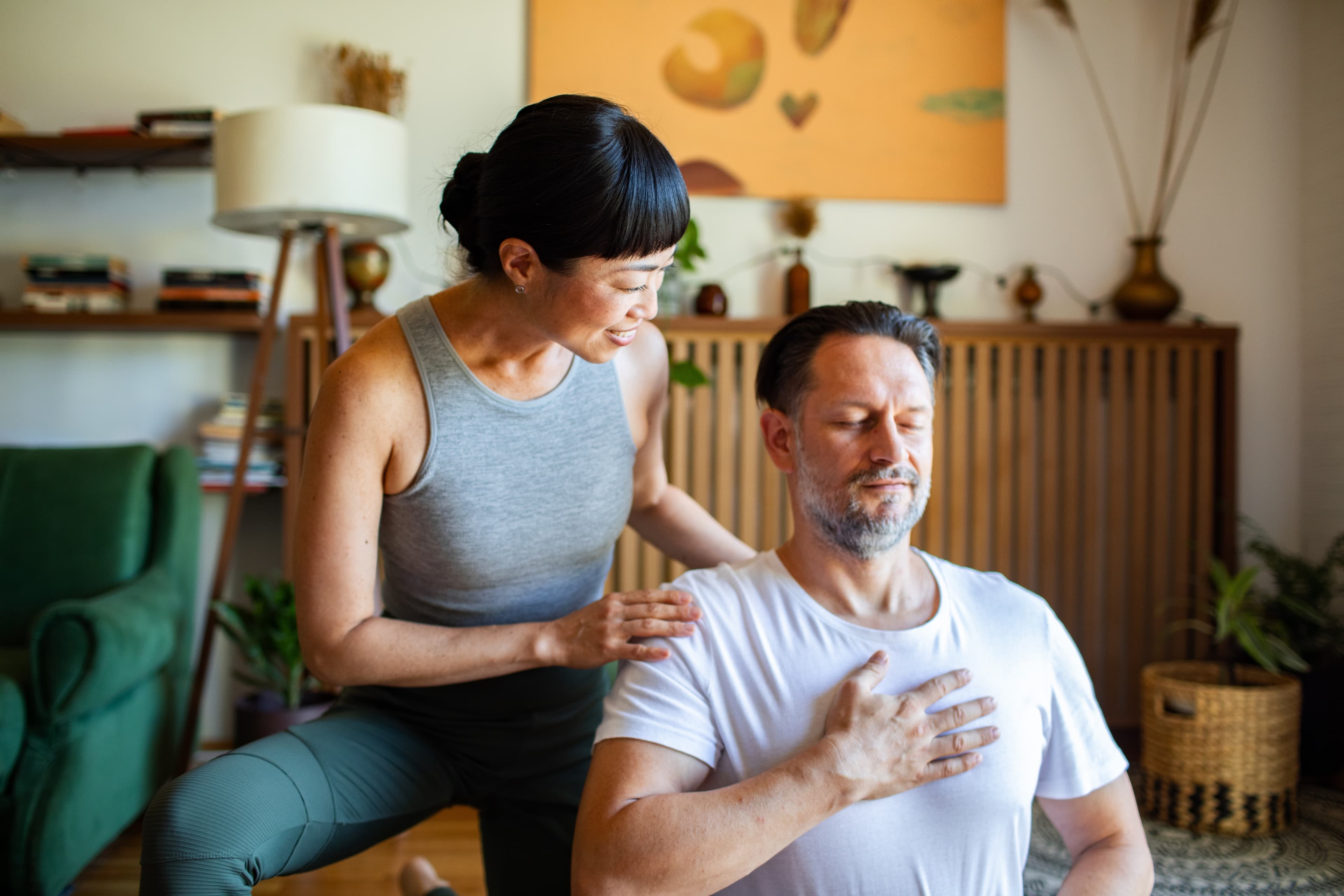
Hold your arm straight out in front of you. Someone presses down on your wrist for two seconds, lightly, and your arm either stays or drops. That is the entire mechanical event behind a kinesiology session, and it is also the event most misrepresented on the internet, where it is sold as a lie detector, an allergy screen and a way to choose supplements. I have spent ten years in private practice with that arm, and I wrote a 600-page manual about what it can and cannot tell you. Here is the short version.
This article stays on the test itself. If you want the broader picture of what a kinesiologist does with the results, read our plain-language explanation of kinesiology; if you want the classroom hours, modules and cost, read what kinesiology certification covers.
What is a manual muscle test, mechanically?
A myotatic reflex, which is an involuntary contraction of a muscle in response to its own stretch. When the tester applies a brief push to an extended limb, the muscle spindle sends a sensory signal to the spinal cord and the signal returns as a reflex. In my Grand Manuel de Kinésiologie (Dunod, 2025) I describe the two directions of that loop. A pinch shortens the muscle fibre and, through the body's own balancing, the muscle then relaxes: a weak test. A depinch lengthens the fibre and the muscle contracts: a strong test.
The important word is reflex. The test is not measuring strength in the gym sense. A strong test and a weak test differ by a fraction of a second in whether the fast-twitch fibres fire to hold the position against a light, sustained push. That is why the pressure is light, around the weight of a hand, and why a tester who leans on the arm is no longer testing anything.
What do lock and give mean?
Lock means the arm holds; give means it drops. The manual reduces the whole vocabulary to one binary line: on or off, yes or no, strong test or weak test, muscle locked or released, contracted or relaxed. Everything a kinesiologist does with the test is built on that single bit of information, repeated many times with different questions, touches or positions in between.
Two rules from the manual follow. First, follow the test: the practitioner reads the response, never steers it. Second, and I put this in capitals for students: do not say my test. It does not belong to you. The moment a tester expects an answer, the pressure changes without them noticing, and the test starts reporting the tester's expectation instead of the client's response. Keeping your own opinion out of your hand is the hardest skill of the first year.
From the training floor
In every cohort, the first two days produce arms that test strong for everything. Beginners press too hard, too fast, or with a hopeful face. By day three, most students can feel the difference between a locked and a released deltoid without looking. The ones who struggle longest usually already believe they know what the answer should be.
Why do we run three pre-checks before any question?
Because a test that is not clear is not a test. The manual describes a complete session as pre-tests followed by the body of the session, and the pre-tests exist to make sure the instrument is working before anyone reads it. There are three, and each has a test and a correction.
| Pre-check | What it screens for | How it is tested | Correction if it fails |
|---|---|---|---|
| Hydration | Whether nerve signalling is adequate; the manual notes water improves physical and mental coordination | Tester pulls gently on a lock of the client's hair while testing the indicator muscle | The client drinks a glass of water and the test is repeated |
| Polarity, also called switching | Whether the nervous system adapts to a change of orientation; linked to the person's capacity to adapt under stress | Three tests with the tester's hands placed laterally, then crossed, then laterally again on the extended arms; all three should test strong | Hand cupped around the navel while stimulating specified points on the governing and conception vessels and the kidney meridian |
| Clear indicator muscle | Whether the muscle gives a readable yes and a readable no rather than a defence pattern | Client says YES, expected strong; client says NO, expected weak | If everything tests strong or everything weak: cross-crawl movements; if the answers are inverted: tapping around the ears while repeating an acceptance phrase and tracing a lying figure eight with the eyes |
Which muscle is the indicator, and why the anterior deltoid?
The anterior deltoid, the muscle at the front of the shoulder that raises the arm forward, because it is easy to isolate, easy to reach on a seated or standing client, and tolerant of many repetitions. The manual describes both positions: arms extended forward, pushing up against the tester's hands, then a sudden release; or arms at the sides, pushing back against the tester's hands behind the forearms. The tester provides a brief resistance and the client simply holds.
One muscle is enough for the yes-and-no work. Our kinesiology curriculum goes further and teaches 14 muscle indicators, each associated in the Touch for Health tradition with a meridian and a balancing protocol. Each has its own position, its own direction of pressure and its own ways of being faked by a client who recruits neighbouring muscles, so students practise on classmates until an instructor can watch ten tests in a row and see no drift.
Which three schools shaped the method?
Three, and I built my own teaching around them. Touch for Health, created in the 1970s by the chiropractor John Thie to make muscle testing usable in a family setting, gave the field its meridian-muscle map and its balancing techniques; the Touch for Health curriculum is still the most widely taught entry point in the United States. Three In One Concepts added emotional-stress defusion and the idea that memories of stress can be located in time. Brain Gym, from educational kinesiology, brought movement-based work on how the brain organises perception and learning.
In the manual, I renamed those three lineages as the three branches of the discipline: Energy, Meridians and Structure from Touch for Health; Wounds, Memories and Behaviours from Three In One; and Brain, Movement and Learning from Brain Gym. Our May 2026 survey of U.S. providers found the domestic market is modular by design, sold as stacked weekend levels by independent instructors, which is why we teach all three branches inside one cohort. Lineage matters here; our essay on lineage in holistic training explains why.
What does the research on reliability show?
Two different things, depending on what is being tested. When researchers ask whether trained testers agree on whether a muscle is strong or weak, agreement is moderate to good, and it improves with training and a standardised pressure. When researchers ask whether muscle testing can identify a substance, a hidden statement or a medical condition, controlled trials find it performs about as well as guessing.
What the evidence shows
Systematic reviews of manual muscle testing draw the same line: as a manual assessment of relative muscle response, inter-examiner reliability is acceptable when testers are trained; as a diagnostic tool, or as a method for testing substances, it lacks validity. Blinded trials in which testers tried to distinguish allergens from placebo vials by muscle response found results consistent with chance. We teach students to read those trials in module one.
What will we never use muscle testing for?
Diagnosis, substances and medical decisions. The code of ethics that opens my manual says it in one line: the kinesiologist establishes neither diagnosis nor treatment. Kinesiology is a holistic, non-medical approach, a set of techniques for managing stress and emotions. The manual adds that the practitioner makes no prescription, never asks a client to stop a medical treatment, and avoids any term that could suggest kinesiology is a medicine or a healing practice.
- No allergy or intolerance testing. Holding a vial of pollen or a slice of bread while testing an arm does not identify an allergy. Allergy testing is a medical act with real consequences if wrong.
- No supplement or remedy selection. Testing a bottle against a client's arm is a sales technique dressed as assessment, and we do not teach it.
- No medical questions. The test is never asked whether a client has a disease, needs a medication or should stop one.
- No lie detection. A muscle test reads stress, not truth. People test weak on true statements that frighten them and strong on comfortable falsehoods.
Scope of practice
A kinesiology practitioner in the U.S. holds a private certification, not a licence. Using muscle testing to diagnose, to recommend or discontinue medication, or to test for allergies can constitute unlicensed practice of medicine. The test is used to identify stress and to select a balancing technique, and the client is referred to a licensed provider for anything medical. Confirm your state's rules with the state board before you take clients.
How long does it take to get a reliable test?
About three days to feel the difference and many more sessions to trust it. The reliable hand comes with repetition, when the person on the table is not a classmate who wants you to succeed but a stranger who is tired, sceptical or nervous, and the test has to work anyway.
- 1
Days 1 and 2: the instrument
Deltoid test in both positions, the three pre-checks and their corrections, and the discipline of light, brief, neutral pressure.
- 2
Days 3 to 5: the 14 indicators
Each muscle, its position, its meridian and its balancing protocol, tested on at least three different bodies per day.
- 3
Days 6 to 8: the session
Setting a positive goal, locating when a stress was fixed, applying balances from the three branches, and closing with aftercare.
- 4
Between sessions: personal study
About 50 hours of reading, practice and preparation between classroom days, on average.
That is the shape of our in-person kinesiology program: 9 classroom days (63 teaching hours), plus about 58 hours of personal study between sessions, for $2,520, in cohorts of ten. I kept the muscle test in the room, taught hand to arm, because it is the one skill in this field that a screen cannot transmit. You can watch a thousand videos of an arm being pressed and still not know what a lock feels like under your own fingers. How practice hours work across the field is covered in our guide to practice hours.
Questions on this topic.
Is muscle testing scientifically valid?+
It depends on the claim. As a manual assessment of whether a muscle holds or gives under light pressure, trained testers agree with each other reasonably well, and the underlying stretch reflex is well described. As a way of identifying substances, allergies, diseases or hidden truths, controlled trials find it performs about as well as chance, and reviews conclude it lacks diagnostic validity. Serious programs teach it only as a stress-feedback tool and say so.
Can muscle testing detect food allergies or intolerances?+
No. Blinded trials in which testers tried to tell allergens from placebo vials by muscle response found results consistent with guessing, and allergy testing is a medical act with real consequences if wrong. A kinesiologist who tests food or supplements against a client's arm is outside the evidence and, in most states, outside the law. Anyone concerned about an allergy should see an allergist; a kinesiology session is not a substitute.
Why does my arm go weak during muscle testing?+
Because the test reads a brief change in a stretch reflex, not your strength. When a light push is applied to an extended arm, the muscle either fires fast enough to hold or it does not. Stress, a startling question, dehydration, an unclear indicator, or a tester pressing too hard or too fast can all produce a weak response. That is why trained practitioners run three pre-checks before they read anything and keep the pressure light and neutral.
What is the difference between applied kinesiology and holistic kinesiology?+
Applied kinesiology is a system developed by the chiropractor George Goodheart in the 1960s and used mainly by chiropractors within their licensed scope. Holistic or specialised kinesiology grew from it through Touch for Health, Three In One Concepts and Brain Gym, and is practised by non-licensed practitioners as a stress-management approach. Both use manual muscle testing, but holistic kinesiology makes no diagnostic claims and stays within a non-medical, private-certification scope.
Can you do muscle testing on yourself?+
Self-testing methods exist, such as finger-ring tests or a standing sway test. They are less reliable than a two-person test because the same nervous system is asking the question and producing the answer, so expectation leaks in easily. In training we teach self-testing only after the two-person test is solid, and we advise against using it for any decision that matters, including anything to do with food, supplements or health.
How much pressure is used in a muscle test?+
Light and brief. The tester applies roughly the weight of a hand to the extended arm for about two seconds, enough to ask the muscle to hold, not enough to overpower it. A tester who leans on the arm is measuring strength, which is not the point, and a tester who pushes for five seconds tires the muscle. Consistency matters more than the exact force; trained testers practise until their pressure is the same on every test.
What does switching mean in kinesiology?+
Switching, also called polarity testing, is one of the three pre-checks done before a session. It screens whether the client's nervous system adapts to a change of orientation: the tester places their hands laterally, then crossed, then laterally again on the extended arms and tests each time. All three should test strong. If one tests weak, the person is considered switched and a correction is done, typically hand contact around the navel with stimulation of specific points, before any question is asked.
Does muscle testing work if the tester expects an answer?+
Not reliably. The tester's expectation changes the timing and force of the push without their noticing, and the arm then reports the tester's belief rather than the client's response. This is the main threat to the test's reliability and the reason training spends so long on neutral pressure and on following the test rather than steering it. Practitioners who cannot keep their opinion out of their hand get answers that confirm what they already thought.
Tags:
KinesiologyWhat it isScope of practice
About the author
Valérie Fabre · Founder & Director, Harmonika Institute
Valérie Fabre founded Harmonika Institute in 2025, after a decade seeing clients in private kinesiology practice and, before that, thirteen years in international trade. A French-born polyglot who now splits her time between Dallas and Miami, she sets the school's curriculum and editorial standards and champions ethical, in-person training.
Read more about Valérie Fabre →