harmonikaInstitute
Contact us
Certified Reflexology Practitioner

Reflexology training and certification

Reviewed byJanet O., CRP · Harmonika FacultyLast updated

Reflexology at Harmonika Institute is taught as a clinical craft. You'll learn the maps of the feet, hands, and ears, refine your thumb-walking and finger-walking technique through hours of paired work, and run complete supervised sessions on members of the public. The program is structured around clear scope of practice: regulation varies by U.S. state, and graduates leave knowing exactly what they may and may not offer in their location, and what additional credentials (such as ARCB) they may pursue.

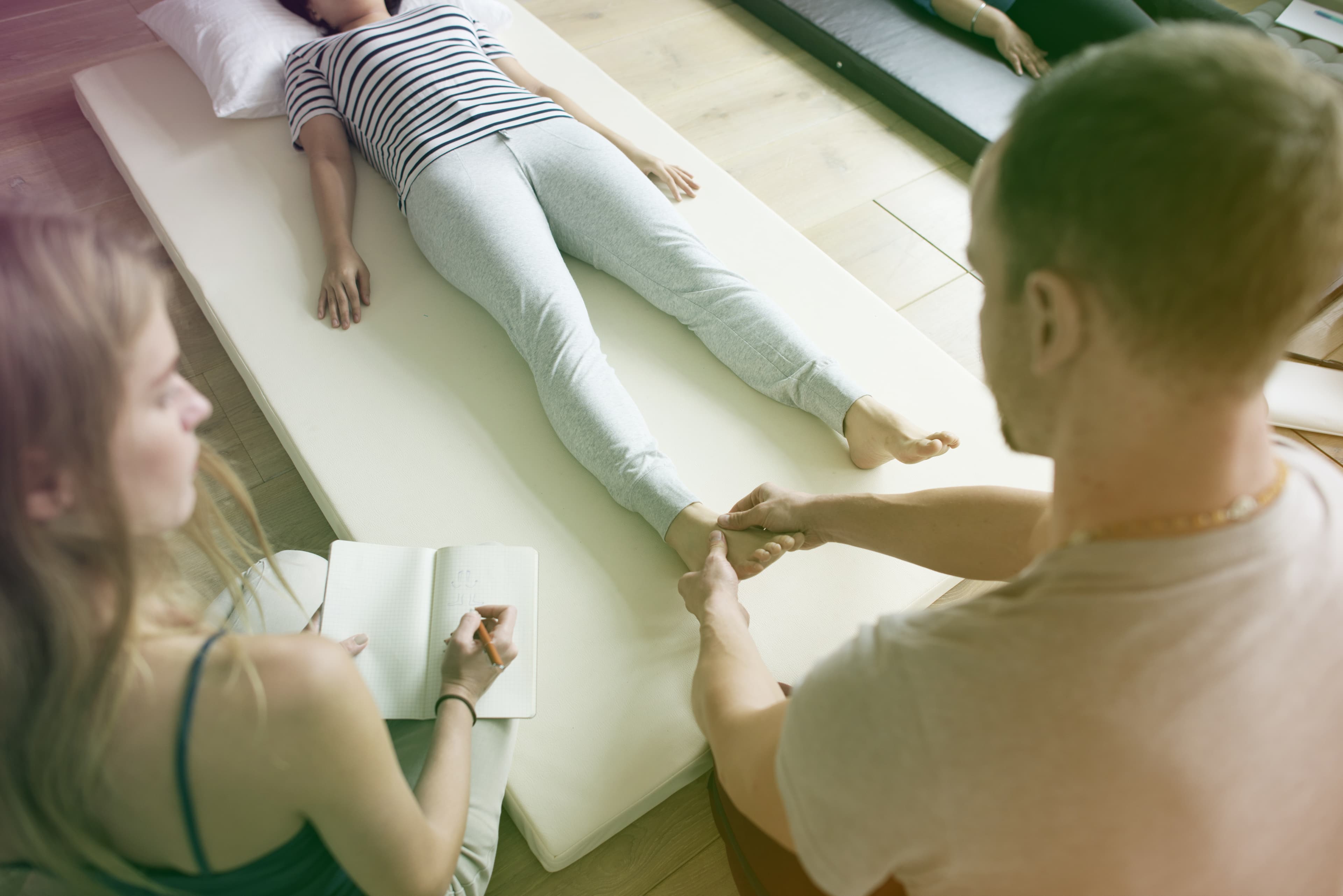
Reflexology training in person at Harmonika Institute

Program at a glance

Credential
CRP
Tuition
$3,200
In-person training
12 days · 96h
Live cohort calls
1 day · 4h
Supervised practice
80h
Immersion stage
4 days · 32h
Portfolio + jury
50h
Total
262h · ~33 day-eq.
Cohort size
10 students
Format
In person + live cohort calls
Includes
Table-based work
Download detailed program (PDF)

PDF — modules, hours, faculty notes, and a typical week's schedule.

Reflexology training in the U.S.

Looking for a reflexology certification online alternative, reflexology courses, or a reflexology training program in the United States? Harmonika Institute's Certified Reflexology Practitioner (CRP) course is a 15-day in-person training across ten U.S. cities — fully in person, never online, because reflexology is a hands-on craft that cannot be transmitted through a screen. We teach the foot, hand, and ear reflexology maps, the thumb-walking and finger-walking technique that distinguishes a competent reflexologist, and the full one-hour session protocols that working practitioners use. The program is grounded in the U.S. state-by-state regulatory landscape: regulation varies (Washington and New Hampshire require specific reflexology credentials; many states have no regulation), and graduates leave knowing exactly what they may offer in their location.

The modality

What is reflexology?

Reflexology is a structured hands-on practice that works through specific points on the feet, hands, and ears that are mapped to correspond to organs, glands, and systems throughout the body. The reflexologist applies precise pressure with thumbs and fingers — a technique called thumb-walking and finger-walking — to those reflex points, working through a systematic protocol that covers the full body via the feet, hands, or ears.

A typical foot reflexology session lasts 60 minutes. The client lies clothed on a treatment table with feet elevated and accessible. The practitioner spends a few minutes with intake conversation, then settles into a slow, deliberate working of the feet — typically forty-five minutes of actual reflexology bracketed by intake and integration. Hand and ear reflexology sessions are commonly 30 to 45 minutes and are particularly useful for clients with foot contraindications.

Reflexology has a distinctive professional quality among holistic modalities. It is more structured than generic energy work (you have a defined map of points to work), more predictable in client experience (most clients feel deeply relaxed afterwards), and unusually portable (a reflexology practice can run from any quiet room with a treatment chair or table). U.S. demand is strong: spas, wellness centers, hospital integrative-medicine programs, and private practices all employ reflexologists.

The U.S. regulatory landscape is varied. A few states (Washington, New Hampshire) have specific reflexology credentialing requirements; many states have no specific regulation; in some states reflexology is treated as a subset of massage therapy under massage licensing rules. Harmonika Institute teaches the regulatory landscape state by state, so graduates know exactly what they may legally offer in their location and what additional credentials (such as ARCB — American Reflexology Certification Board) they may pursue.
History & lineage

Where this work comes from.

Reflexology has roots in multiple ancient cultures — Egyptian (the Tomb of Ankhmahor depicts what may be foot work, c. 2330 BCE), Chinese, and Indian. Modern Western reflexology was systematized primarily by Eunice Ingham (1889–1974), an American physiotherapist who developed the foot map and the thumb-walking technique that remain the foundation of contemporary practice. Her niece, Dwight Byers, founded the International Institute of Reflexology to continue her work. Today the field has multiple credentialing bodies (ARCB, RAA, NCBTMB-recognized programs) and extensive professional literature. Harmonika Institute's curriculum is informed by the Ingham method (the most widely-taught modern foundation) with significant additional material on hand and ear reflexology.

Why structured training matters

Beyond books and weekend workshops.

Reflexology requires manual skill that cannot be developed through a reflexology certification online. Thumb-walking technique in particular — the ability to apply consistent, calibrated pressure through the thumb in a deliberate caterpillar-like progression — takes hundreds of supervised hours to develop. Pressure that is too light produces no result; pressure that is too heavy bruises feet and produces sore practitioners. The skill has to be practiced under direct observation. Our 15-day in-person program is designed around the manual skill development and the supervised client hours that competent reflexology requires.

What you'll learn

Skills you'll leave with.

The 262 hours of this program are built around the following competencies. Most are practiced rather than lectured.

  • Foot, hand, and ear reflexology maps
  • Thumb-walking, finger-walking, and pressure modulation
  • Full one-hour foot reflexology session protocols
  • Hand and ear protocols for clients with foot contraindications
  • Reading state-by-state regulation in the U.S.
  • Building a reflexology practice: pricing, kit, marketing
Curriculum

Module by module.

Module 1 — Foundations

History, maps, scope of practice, contraindications.

Module 2 — The foot session

Full one-hour foot reflexology, thumb-walking, sequencing.

Module 3 — Hands & ears

Hand and ear maps and full session protocols.

Module 4 — Specific populations

Pregnancy, older adults, oncology-adjacent (with referral).

Module 5 — Regulation

U.S. state-by-state requirements and pathways like ARCB.

Module 6 — Practice & business

Pricing, kit, ongoing supervision.

Program highlights

Specifics that distinguish the Reflexology cohort.

01

Foot, hand, and ear maps complete

Most U.S. reflexology programs cover feet only. We teach the full triad — making graduates more versatile and able to work with clients who have foot contraindications.

02

Thumb-walking under faculty observation

The technique that distinguishes a competent reflexologist takes hundreds of supervised hours to develop. We give it the time it requires.

03

ARCB-aligned curriculum

Our content aligns with American Reflexology Certification Board standards — graduates pursuing ARCB certification find most of our hours count.

04

State-by-state regulation map

Reflexology regulation varies dramatically — Washington and New Hampshire require state credentials, others don't. We cover the landscape thoroughly.

05

Pregnancy reflexology specialty

One of the highest-paying reflexology specializations. Taught as a standalone module with contraindication training.

Why this program

What makes our Reflexology training different.

Foot, hand, and ear reflexology

Most U.S. reflexology programs focus on feet only. We teach the full triad — foot, hand, and ear maps — which makes graduates more versatile and able to work with clients who have foot contraindications.

Manual skill emphasized

Most of your hours are spent thumb-walking, finger-walking, and refining your pressure under direct faculty observation. Without this, the technique remains theoretical.

State-by-state regulatory clarity

U.S. reflexology regulation varies widely. We teach the landscape state by state so graduates know exactly what they may offer in their location and what additional credentials they may pursue.

ARCB-aligned curriculum

Our curriculum is structured to align with American Reflexology Certification Board standards, so graduates who choose to pursue ARCB certification can do so without significant additional preparation.

Supervised paid client hours

Every student logs supervised paid sessions on members of the public during the program — not just demonstrations on classmates.

Practice-building included

Pricing, marketing, intake forms, scope of practice, and the legal frame for running a reflexology practice in your specific U.S. state are part of the curriculum.

A day in the practice

What working as a CRP actually looks like.

A working reflexologist two years out: morning self-care and a few minutes of hand reflexology on yourself — keeping your own practitioner-body in good shape is essential to a long career. First client at 10am, 60-minute foot reflexology session, $90. You take 15 minutes for notes and tea. Second client, 60 minutes, $90. Lunch break. Afternoon brings three more clients: another 60-minute foot session, a 45-minute hand reflexology session ($70), and a 60-minute foot session. By 6pm you have run six sessions and grossed $520. Reflexology practices are unusually steady — clients come back regularly, often every two or three weeks — and the work is well-suited to high session volume because it is more predictable on the practitioner-body than deep massage. Most weeks: twenty to twenty-five sessions, grossing $1,800–$2,500.

Career outcomes

After graduation.

  • Open a private Reflexology practice (CRP)
  • Offer reflexology in spas, wellness centers, and corporate settings
  • Specialize in pregnancy, older-adult, or sports reflexology
  • Pursue ARCB certification where state-recognized
  • Add reflexology to a massage, energy, or bodywork practice
Career path

Trajectory and income for Reflexology practitioners.

Reflexologists typically build private practices with strong return-client rates. Pricing is more uniform than for some modalities — typically $80–$120 per 60-minute session in major U.S. cities — but session volume can be high (15–30 sessions per week is realistic for full-time work, more than for most one-on-one modalities). Many graduates work in hybrid arrangements: 50% private practice, 50% spa or wellness-center contracted work. Specializations that support higher pricing include pregnancy reflexology, oncology-supportive reflexology (often within integrative medicine settings, working alongside licensed care), and sports reflexology. Annual gross income for full-time practitioners ranges from $55,000 to $130,000 within three to five years.

How it compares

Reflexology compared to adjacent modalities.

Reflexology vs. Massage Therapy

Massage works the full body's soft tissue with sustained pressure; reflexology works specific reflex points on the feet, hands, and ears with thumb- and finger-walking technique. The two are complementary; many graduates work as both LMTs and reflexologists.

Reflexology vs. Acupressure

Both work specific points, but acupressure works points distributed across the full body and is rooted in Traditional Chinese Medicine meridian theory; reflexology works specifically on the feet, hands, and ears with a mapping system that traces back primarily to Eunice Ingham's work.

Reflexology vs. Foot Massage

Foot massage works the feet for relaxation; reflexology applies precise pressure to specific reflex points with the intention of supporting the body's overall regulation. The trained reflexologist's session is more deliberate and structured than a foot massage.

Evidence & research

What the research says about Reflexology.

We teach with intellectual honesty. Where the evidence is strong, we say so. Where it is weak, we say that too. Our credibility — and our graduates' — depends on it.

The research base for reflexology is mixed. Multiple RCTs have examined reflexology for specific applications — pregnancy nausea, chemotherapy-associated symptoms, anxiety, sleep, premenstrual symptoms — with results ranging from significant positive effects to no effect beyond placebo controls. A 2011 systematic review in Maturitas (the European Menopause Journal) found generally positive effects on women's-health-related symptoms. A 2014 review in Complementary Therapies in Clinical Practice found reflexology effective for relaxation and modestly effective for pain. The mechanism by which specific foot points correspond to organ systems remains scientifically unestablished — current physiology does not support the foot-map model in its traditional form. The general effects of structured foot work (pressure-induced parasympathetic activation, focused attention from a calm practitioner, sustained quiet time) are well-supported by adjacent research on touch and slow bodywork. We teach reflexology at Harmonika Institute with this nuanced research base in mind: the specific foot-map theoretical claims are not strongly supported, the practical effects of skilled reflexology are well-documented, and graduates speak about the work with credibility.

Common misconceptions

What people get wrong about Reflexology.

Myth

Reflexology can diagnose organ problems through the feet.

Reality

It cannot. The foot-map correspondence model is not supported as a diagnostic tool. We teach reflexology explicitly as a non-medical wellness practice.

Myth

Reflexology is just foot massage.

Reality

Foot massage works the feet for relaxation; reflexology applies precise thumb- and finger-walking pressure to specific reflex points with intentional structure. The practitioner training is substantially more demanding.

Myth

Reflexology can be learned in a weekend.

Reality

The maps can be memorized in a weekend. The thumb-walking technique that distinguishes a competent reflexologist requires hundreds of supervised practice hours.

Myth

Reflexology is unregulated nationally.

Reality

Federal regulation is light, but state regulation varies significantly: Washington and New Hampshire require state credentialing, several states regulate reflexology under massage-therapy rules, others have no specific regulation. We teach the state-by-state landscape during the program.

Can I learn this on my own?

Self-study vs. structured Reflexology training.

A question we get from many applicants. Here is the honest answer.

Can you learn reflexology on your own? You can memorize the reflexology maps from books (Eunice Ingham's foundational texts, Kevin and Barbara Kunz's modern works, many others). What you cannot develop alone is the thumb-walking and finger-walking technique that distinguishes a competent reflexologist. Calibrated thumb pressure, the deliberate caterpillar-like progression along the foot's reflex zones, the ability to apply the technique for sustained 60-minute sessions without injuring your own hands or producing an inadequate session for the client — these are manual skills that require hundreds of supervised hours to develop. Books cannot watch your thumbs. Our 15-day program is built around exactly this manual development: most of your training is spent thumb-walking and finger-walking under direct faculty observation, with feedback on pressure, sequencing, and pacing. The maps you can largely learn alone; the technique that delivers them you cannot. Graduates leave able to run a full one-hour foot session, work hands and ears for clients with foot contraindications, and pursue ARCB certification where their state recognizes it.

What graduates carry forward

Beyond the certification.

Graduates of our Reflexology program carry forward a working manual skill that takes hundreds of hours to develop and serves them for decades. Thumb-walking calibration, sustained pressure for hour-long sessions without injuring your own hands, the ability to read feet that have walked very different paths through life — these are physical skills that mature with experience. Five years out, our reflexologists are running practices that can support family-supporting income with high client retention. The career builds on the consistency. The hands themselves become a long-term professional asset.

Key concepts & people

The Reflexology vocabulary you'll learn.

These are the lineages, named teachers, frameworks, and technical terms our curriculum draws on. By graduation, you'll know each of them in depth.

Modern foundation

Eunice Ingham
1889–1974. American physiotherapist; systematized modern foot reflexology.
Dwight Byers
Ingham's nephew; founded International Institute of Reflexology.
Kevin and Barbara Kunz
Senior reflexology authors and teachers.

Maps

Foot reflexology
Original Ingham mapping; sole, dorsum, sides.
Hand reflexology
Hand correspondence map; useful for foot-contraindicated clients.
Ear (auricular) reflexology
Ear-based map; overlaps with TCM auricular acupuncture points.

Credentialing

ARCB
American Reflexology Certification Board; recognized in some U.S. states.
RAA
Reflexology Association of America.
Washington / New Hampshire
States with specific reflexology credentialing requirements.
Books & further reading

Recommended reading on Reflexology.

These are the books our faculty actually recommend to enrolled students — not a comprehensive bibliography, but a practical starting point.

Reflexology: The 5 Elements and their 12 Meridians

Inge Dougans

Strong synthesis of reflexology with TCM five-elements theory. Useful for graduates pairing reflexology with acupressure.

Reflexology: Health at Your Fingertips

Barbara and Kevin Kunz

Practical, well-illustrated reference. The Kunzes' books are the most widely-used English reflexology references.

Stories the Feet Can Tell

Eunice Ingham

The 1938 foundational book by the founder of modern Western reflexology. Historical context.

Hand Reflexology

Mildred Carter and Tammy Weber

Specific to hand work. Particularly useful for graduates with foot-contraindicated clients.

The right student

Is this program for you?

Bodyworkers, massage therapists, and career-changers who want a structured, hands-on practice with predictable demand and clear scope.

Prerequisites

What we expect on day one.

None.

Tuition & financing

$3,200 for the full 33-day program.

Tuition covers 12 days of in-person teaching, 1 live cohort intervisions, 80h of supervised practice, a 4-day immersion stage with a senior practitioner, portfolio review and a final jury evaluation, and one year of post-graduation support. Interest-free monthly installments. A 25% deposit confirms your cohort spot.

$3,200

262h total · 12 in-person days · cohort of 10

People also ask

Common questions about Reflexology training.

How long does the reflexology certification take?

15 days from start to graduation, in person, in your city.

Can I take reflexology certification online?

Some online programs exist, but reflexology is fundamentally a manual skill — thumb-walking, finger-walking, calibrated pressure — that cannot be developed without supervised in-person practice. Our program is fully in person.

What credential do I receive?

Certified Reflexology Practitioner (CRP) — a private Harmonika Institute credential. The curriculum is structured to align with ARCB standards, so graduates who wish to pursue ARCB certification can do so as a complementary further step.

More questions

Do I need any prior bodywork training?+

No. Reflexology builds from foundations.

Can I run paid sessions after graduation?+

Yes — but check your state's specific regulations. Most states have no specific reflexology licensure; a few (Washington, New Hampshire) require state credentials. We cover the state-by-state landscape during the program.

How much does the reflexology training cost?+

Total tuition is $4,500, with monthly payment plans available across the 15 days of the program.

Is the course online or in person?+

Fully in person. Reflexology cannot be effectively learned online.

Can I add reflexology to my existing massage practice?+

Yes — and many of our students are already LMTs adding reflexology as a complementary service.

Will I learn pregnancy reflexology?+

Pregnancy reflexology is a specialty within reflexology with its own contraindications. We cover it as one specialization track during the program; some graduates pursue further specialty training afterward.

Where it's taught

Reflexology is offered in 32 cities.

Northeast

New York

New York

Reflexology in New York

West

Los Angeles

California

Reflexology in Los Angeles

Midwest

Chicago

Illinois

Reflexology in Chicago

South

Miami

Florida

Reflexology in Miami

South

Houston

Texas

Reflexology in Houston

Northeast

Boston

Massachusetts

Reflexology in Boston

South

Atlanta

Georgia

Reflexology in Atlanta

Pacific Northwest

Seattle

Washington

Reflexology in Seattle

Mountain West

Denver

Colorado

Reflexology in Denver

South

Austin

Texas

Reflexology in Austin

Mid-Atlantic

Philadelphia

Pennsylvania

Reflexology in Philadelphia

Mid-Atlantic

Washington

District of Columbia

Reflexology in Washington

Southwest

Phoenix

Arizona

Reflexology in Phoenix

Midwest

Detroit

Michigan

Reflexology in Detroit

West

San Francisco

California

Reflexology in San Francisco

West

San Diego

California

Reflexology in San Diego

Midwest

Minneapolis

Minnesota

Reflexology in Minneapolis

South

Tampa

Florida

Reflexology in Tampa

Southwest

Las Vegas

Nevada

Reflexology in Las Vegas

Mid-Atlantic

Baltimore

Maryland

Reflexology in Baltimore

Midwest

St. Louis

Missouri

Reflexology in St. Louis

Pacific Northwest

Portland

Oregon

Reflexology in Portland

South

San Antonio

Texas

Reflexology in San Antonio

West

Sacramento

California

Reflexology in Sacramento

South

Orlando

Florida

Reflexology in Orlando

West

San Jose

California

Reflexology in San Jose

Midwest

Indianapolis

Indiana

Reflexology in Indianapolis

Northeast

Pittsburgh

Pennsylvania

Reflexology in Pittsburgh

Midwest

Cincinnati

Ohio

Reflexology in Cincinnati

Southeast

Charlotte

North Carolina

Reflexology in Charlotte

Southeast

Nashville

Tennessee

Reflexology in Nashville

South

Dallas

Texas

Reflexology in Dallas

Next step

Become a Certified Reflexology Practitioner.

Talk with our admissions team about the next Reflexology cohort starting in your city.