How long does the holistic kinesiology certification take?
15 days from start to graduation, in person, in your city.
Holistic Kinesiology at Harmonika Institute teaches you to use muscle testing as a feedback tool, working with the body's own information to guide a balancing session. The program is in-person and table-based: you'll log many hours testing, balancing, and refining your touch with paired partners and supervised members of the public. The training is grounded in clear scope of practice — graduates offer wellness sessions, not medical diagnoses.

Program at a glance
PDF — modules, hours, faculty notes, and a typical week's schedule.
Looking for a kinesiology certification, kinesiology classes, or holistic kinesiology training in the United States? Harmonika Institute's Certified Holistic Kinesiology Practitioner (CHKP) program is a 15-day in-person training across ten U.S. cities, designed for adults who want to use muscle testing as a feedback tool in serious one-on-one client work. We teach the foundational Touch for Health framework, the 14 primary muscle indicators and their balancing protocols, emotional stress release work, and the goal-balancing techniques that distinguish holistic kinesiology from physical-therapy kinesiology. Whether you want to add muscle testing to a yoga or bodywork practice, build a standalone holistic kinesiology practice, or specialize in stress, learning support, or food sensitivities, our kinesiology classes prepare you to work confidently with paying clients on graduation.
Holistic kinesiology is a hands-on, table-based wellness practice that uses manual muscle testing as a biofeedback tool. The practitioner places the client's arm or leg in a specific position and applies light pressure; the change in muscle response — the small ways the muscle either holds or yields — is read as feedback from the body's own information system. From that feedback the practitioner builds a session: balancing specific muscle-meridian pairs, addressing emotional stress patterns associated with specific points, and supporting the client toward a stated goal.
Holistic kinesiology should not be confused with academic kinesiology — the university-level study of human movement that prepares students for physical therapy or athletic training. The two share a name but are different fields. Holistic kinesiology grew out of George Goodheart's Applied Kinesiology in the 1960s and was popularized in non-medical wellness practice through John Thie's Touch for Health system in the 1970s. Today it is one of the most widely-practiced hands-on modalities in the U.S. wellness market.
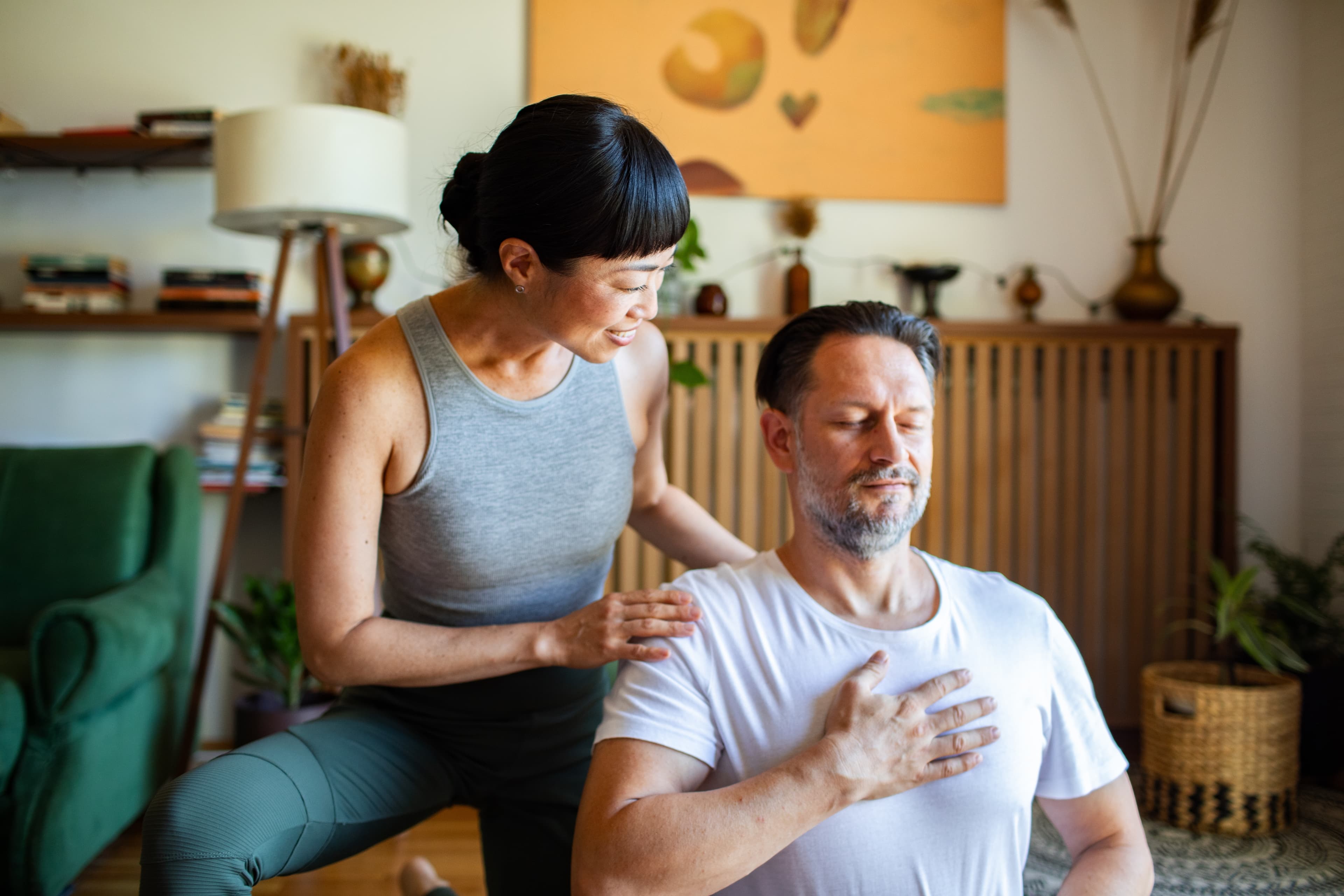
A typical holistic kinesiology session lasts 60 to 90 minutes. The client lies clothed on a treatment table while the practitioner conducts an initial intake, identifies a specific goal for the session, and uses muscle testing to map the body's response to that goal. The practitioner then applies specific balancing techniques — light touch on meridian points, gentle tracing of energy pathways, emotional stress release with light fingertip contact on frontal eminences — guided by the body's continuing feedback through the testing.
What makes holistic kinesiology unusually appealing as a practice is that it is genuinely client-centered: the body's own feedback shapes the session, rather than a predetermined protocol the practitioner imposes. Clients often experience the work as deeply personal and adaptive. Practitioners often describe it as humbling — the practice asks you to trust the body's information rather than your own assumptions.
Applied Kinesiology (AK) was developed by George Goodheart, a chiropractor, in 1964. Touch for Health (TFH) — a simplified, non-medical adaptation of AK for lay practitioners — was developed by John Thie, also a chiropractor, in 1973. From those two foundational systems a wider ecosystem grew: Educational Kinesiology / Brain Gym (Paul Dennison), Three In One Concepts, Health Kinesiology, Specialized Kinesiology, and many adjacent lineages. Harmonika Institute's curriculum is rooted in Touch for Health (the most widely-taught lay-practitioner kinesiology system globally) with significant additional material drawn from Three In One and Brain Gym for the emotional-stress-release and learning-support aspects of the work.
Holistic kinesiology requires manual skill that cannot be developed without supervised practice. Muscle testing in particular is harder than it looks — the practitioner has to learn to apply consistent, calibrated pressure, to read the body's response without imposing their expectation, and to refine the test through hours of work with many different bodies. A weekend workshop can introduce the framework. Six months of in-person work, with direct faculty observation of every test, is what builds reliable, professional-grade testing skill.
The 178 hours of this program are built around the following competencies. Most are practiced rather than lectured.
Muscle testing basics, scope of practice, the body's feedback.
Each muscle, its meridian, and its balancing protocol.
Emotional stress release and goal-balancing techniques.
Intake, full session arc, integration, aftercare.
Ethics, scope, pricing, ongoing supervision.
We teach the canonical Touch for Health curriculum (the global standard for lay-practitioner kinesiology) plus material from Three In One and Brain Gym.
Most of your hours are spent muscle-testing under direct faculty observation. The skill cannot be self-taught — it requires real-time feedback.
Each muscle gets dedicated attention with paired practice — locating, testing, balancing through its meridian-point pair.
The frontal-eminence ESR technique is one of the most useful skills in the kinesiology toolbox. We give it the time it deserves.
Beyond muscle-by-muscle work, we teach the goal-balancing protocols that turn a session into a coherent arc around what the client actually came in for.
We teach the canonical Touch for Health curriculum (the global standard for lay-practitioner kinesiology) plus significant additional material from adjacent lineages.
Most of your hours are spent muscle-testing under direct faculty observation. The skill cannot be self-taught.
The frontal-eminence emotional-stress-release work is one of the most useful skills in the kinesiology toolbox; we give it the time it deserves.
Beyond muscle-by-muscle work, we teach the goal-balancing protocols that turn a session into a coherent arc around what the client actually came in for.
Every student logs supervised paid sessions on members of the public during the program — not just demonstrations on classmates.
Pricing, marketing, intake forms, scope of practice, and the legal frame for running a holistic kinesiology practice are part of the curriculum.
A working holistic kinesiologist two years out: morning self-balancing routine, 20 minutes — practitioners who don't keep their own balance work current end up depleted. First client at 10am, 75 minutes, $160 — a returning client working on chronic stress patterns. You take 15 minutes for notes and a quick clearing. Second client is new: 90-minute first session, $200, including 30 minutes of intake. Lunch break and walk. Afternoon: two more sessions, plus admin. By 5pm you have grossed $640 for four clients. Most weeks: twelve to sixteen one-on-one sessions, grossing $2,500–$4,000. Saturdays once a month you teach a Touch for Health introduction workshop — six attendees at $200 for a one-day workshop, $1,200 gross.
Holistic kinesiologists typically build private one-on-one practices specializing in stress, learning support, food sensitivities, or general wellness balancing. Pricing for one-on-one work is typically $130–$220 per session in major U.S. cities. Many graduates teach Touch for Health introduction workshops to interested community members, both as additional revenue and as effective marketing. A smaller number specialize in specific applications: pediatric learning support, athletic recovery, women's wellness. Annual gross income for full-time practitioners ranges from $65,000 to $140,000 within three to five years.
Two different fields with the same name. Academic kinesiology is the university study of human movement leading to physical therapy or athletic training careers; holistic kinesiology is a non-medical wellness practice using muscle testing as feedback. Our program is the holistic one.
Reiki is purely energetic; kinesiology is biofeedback-driven and table-based. Many practitioners do both, using kinesiology to identify what to work on and Reiki or other energy work as part of the response.
Massage works with sustained physical pressure on muscle and connective tissue; kinesiology uses light touch on meridian points and reflexes guided by muscle-test feedback. Many graduates combine both within a single practice.
We teach with intellectual honesty. Where the evidence is strong, we say so. Where it is weak, we say that too. Our credibility — and our graduates' — depends on it.
Manual muscle testing has a contested research base. Studies examining the inter-rater reliability of muscle testing have produced mixed results: some find acceptable reliability, others find that test results vary substantially between practitioners and even between sessions with the same practitioner. The mechanism by which muscle testing is supposed to access information beyond what the practitioner knows consciously is not scientifically established. At the same time, the broader practices that holistic kinesiology teaches — meridian-point work, gentle reflex stimulation, emotional-stress-release techniques — overlap substantially with acupressure, gentle bodywork, and somatic regulation practices that have stronger independent research support. We teach holistic kinesiology at Harmonika Institute with this intellectual honesty: muscle testing is best understood as a structured ritual that focuses practitioner attention on the client's body and creates a feedback container, not as a literal scientifically-validated information channel. The practical results clients report are real and well-documented in clinical experience; the theoretical mechanisms are debated. Graduates speak about the work with credibility grounded in this nuance.
Myth
Muscle testing reads the body's literal information.
Reality
The scientific evidence does not support this strong claim. Muscle testing is better understood as a structured ritual that focuses practitioner attention and creates a feedback container.
Myth
Holistic kinesiology is medical kinesiology.
Reality
They share a name and nothing else. Medical/academic kinesiology is the university study of human movement leading to physical therapy or athletic training. Holistic kinesiology is a non-medical wellness practice.
Myth
You can test for food allergies through muscle testing.
Reality
Within wellness scope, kinesiology can identify foods a client's body responds to differently and inform a wellness conversation. Medical food-allergy diagnosis remains a clinical service requiring licensed professionals (IgE testing, oral food challenges).
Myth
Anyone can muscle-test after watching a video.
Reality
Reliable muscle testing requires substantial supervised practice. Calibrated pressure, neutral practitioner state, and reading without imposing expectation are skills that take time to develop.
A question we get from many applicants. Here is the honest answer.
Can you learn holistic kinesiology on your own? Conceptual self-study is possible — Touch for Health books, Three In One literature, online resources. What you cannot develop alone is reliable manual muscle testing technique. Muscle testing is harder than it looks: applying consistent calibrated pressure, holding a neutral practitioner state, and reading the body's feedback without imposing your own expectation are skills that take dozens of hours of supervised practice with many different bodies. Books cannot watch your hands. Our 15-day program is built around exactly this: most of your training time is spent muscle-testing under direct faculty observation, with feedback after every session. By graduation the testing has been refined enough to be reliable across varied client populations. The conceptual material — meridian theory, the 14 indicator muscles, emotional stress release, goal balancing — we cover thoroughly, but the heart of the program is the manual skill development. Graduates leave with both the framework and the hands. Self-study graduates from the books rarely develop reliable testing without supervised practice; we have seen this consistently.
Graduates of our Holistic Kinesiology program carry forward a specific kind of clinical literacy. Manual muscle testing, applied with discipline and humility, becomes a sustained conversation with the client's body that informs everything about the session. Five years in, our CHKPs are reading bodies in ways that most weekend-trained practitioners cannot — not because the technique is more complex than the books suggest, but because the practiced discrimination accumulates with hours. The career builds on the accumulating skill. The work stays interesting because the bodies keep teaching.
These are the lineages, named teachers, frameworks, and technical terms our curriculum draws on. By graduation, you'll know each of them in depth.
Lineage
Systems
Techniques
These are the books our faculty actually recommend to enrolled students — not a comprehensive bibliography, but a practical starting point.
Touch for Health: A Practical Guide to Natural Health
John Thie and Matthew Thie
The foundational TFH textbook. Required reading and the source of most modern holistic-kinesiology curricula.
Applied Kinesiology Synopsis
David Walther
The most rigorous AK reference. Dense but useful for understanding the medical-AK tradition that holistic kinesiology adapted from.
Three In One Concepts: Foundation
Gordon Stokes and Daniel Whiteside
Foundation of the emotional-stress-release work that distinguishes our curriculum.
Brain Gym: Simple Activities for Whole Brain Learning
Paul Dennison and Gail Dennison
Educational kinesiology adaptation. Useful for graduates working with learning-support clients.
Bodyworkers, yoga teachers, and career-changers who want to add a powerful biofeedback tool to their work.
None.
Tuition covers 8 days of in-person teaching, 1 live cohort intervisions, 70h of supervised practice, portfolio review and a final jury evaluation, and one year of post-graduation support. Interest-free monthly installments. A 25% deposit confirms your cohort spot.
$2,400
178h total · 8 in-person days · cohort of 10
15 days from start to graduation, in person, in your city.
Holistic kinesiology — a non-medical wellness practice using muscle testing as biofeedback. Academic kinesiology (the university study of human movement) is a separate field that requires a university degree.
Our curriculum is grounded in Touch for Health and equivalent to TFH Levels 1–4 plus additional material. Graduates who want formal Touch for Health Instructor certification (which allows them to teach TFH classes themselves) can pursue that as a complementary further step.
More questions
No. Holistic kinesiology builds from foundations.
Yes. Holistic kinesiology is not a state-regulated profession; as a CHKP you offer paid wellness sessions immediately. Most students take their first paying client during the program itself.
Total tuition is $4,500, with monthly payment plans available across the 15 days of the program.
Fully in person. Muscle testing is a manual skill that cannot be developed online.
Yes — many graduates run combined practices with energy work, bodywork, or coaching credentials.
Food-sensitivity work is one of the curriculum modules. Within a clear non-medical scope, kinesiology can identify foods a client's body responds to differently and inform a wellness conversation. Medical food-allergy diagnosis remains a clinical service requiring licensed professionals.
Northeast
New York
Kinesiology in New York →
West
California
Kinesiology in Los Angeles →
Midwest
Illinois
Kinesiology in Chicago →
South
Florida
Kinesiology in Miami →
South
Texas
Kinesiology in Houston →
Northeast
Massachusetts
Kinesiology in Boston →
South
Georgia
Kinesiology in Atlanta →
Pacific Northwest
Washington
Kinesiology in Seattle →
Mountain West
Colorado
Kinesiology in Denver →
South
Texas
Kinesiology in Austin →
Mid-Atlantic
Pennsylvania
Kinesiology in Philadelphia →
Mid-Atlantic
District of Columbia
Kinesiology in Washington →
Southwest
Arizona
Kinesiology in Phoenix →
Midwest
Michigan
Kinesiology in Detroit →
West
California
Kinesiology in San Francisco →
West
California
Kinesiology in San Diego →
Midwest
Minnesota
Kinesiology in Minneapolis →
South
Florida
Kinesiology in Tampa →
Southwest
Nevada
Kinesiology in Las Vegas →
Mid-Atlantic
Maryland
Kinesiology in Baltimore →
Midwest
Missouri
Kinesiology in St. Louis →
Pacific Northwest
Oregon
Kinesiology in Portland →
South
Texas
Kinesiology in San Antonio →
West
California
Kinesiology in Sacramento →
South
Florida
Kinesiology in Orlando →
West
California
Kinesiology in San Jose →
Midwest
Indiana
Kinesiology in Indianapolis →
Northeast
Pennsylvania
Kinesiology in Pittsburgh →
Midwest
Ohio
Kinesiology in Cincinnati →
Southeast
North Carolina
Kinesiology in Charlotte →
Southeast
Tennessee
Kinesiology in Nashville →
South
Texas
Kinesiology in Dallas →
Next step
Talk with our admissions team about the next Kinesiology cohort starting in your city.