Certified Holistic Kinesiology Practitioner · Chicago, IL
Kinesiology training in Chicago.
Holistic kinesiology suits the table-based, hands-on practitioners Chicago's somatic scene keeps producing — students who want muscle testing grounded in repeatable protocol, not guesswork. The Certified Holistic Kinesiology Practitioner training covers muscle testing, balancing protocols, and full-session craft on the table, with the depth our lineage-minded students expect.
Chicago cohort at a glance
- Tuition
- $4,000
- Format
- 100% in person
- In-person teaching
- 9 days · 72h
- Personal study
- ~58h
- Cohort size
- 10 students
- Credential
- CHKP
Same tuition in every city
In Chicago, IL
8-hour days, two 4-hour half-days
Between sessions, on average
Fixed cohort, start to finish
Private certification, not a state license
PDF — modules, hours, faculty notes, and a typical week's schedule.
Oct 29 – Dec 19, 2027
Fri–Sun · 9 am–6 pm · 9 teaching days in 3 monthly modules · 10 seats per cohort
- Module 1Oct 29–31
- Module 2Nov 19–21
- Module 3Dec 17–19
Every teaching day runs 9 am to 6 pm, in two four-hour half-days. You receive the Chicago venue and the full timetable with your enrolment agreement.
Seats
10 students
Enrolment closes
October 8, 2027
Two minutes, no payment today. Our admissions team contacts you within two business days.
Why Kinesiology in Chicago?
Kinesiology graduates typically build a table practice inside multi-disciplinary wellness spaces in Lakeview or Hyde Park, drawing clients who already use bodywork and want something more structured. The somatic community supplies both peers and referrals. Demand is niche but loyal. The honest caveat: holistic kinesiology is little-known outside these circles, so expect to explain, repeatedly, that it is not the exercise-science field of the same name.
Chicago has been a quiet capital of expressive arts and somatic education in the U.S. for half a century. The city's relationship with the arts — its theater, dance, and visual-art communities — has shaped a wellness scene that is more lineage-aware and less trend-driven than either coast. Our Chicago cohorts tend to be educators, social-services adjacent professionals, and artists in mid-career.
For students of Kinesiology specifically, Chicago's scene is a particularly good match: strong somatic and expressive-arts traditions; lower trend volatility than the coasts. The local cohort runs in venue partners around Wicker Park, Lakeview, West Loop, with public transit and parking accessible from across the metro.
Chicago students are often 35-55, with backgrounds in education, social services, healthcare, or the arts. They tend to ask harder questions during admissions than students in trendier markets, want more substantive curriculum content, and value faculty who can speak about lineage with depth. Many of our Chicago cohorts include licensed clinical social workers (LCSWs), educators with master's degrees, and visual or performing artists — students who bring intellectual rigor to holistic practice.
What you'll be training in.
For a deeper introduction to Kinesiology as a practice tradition, see the full program page.
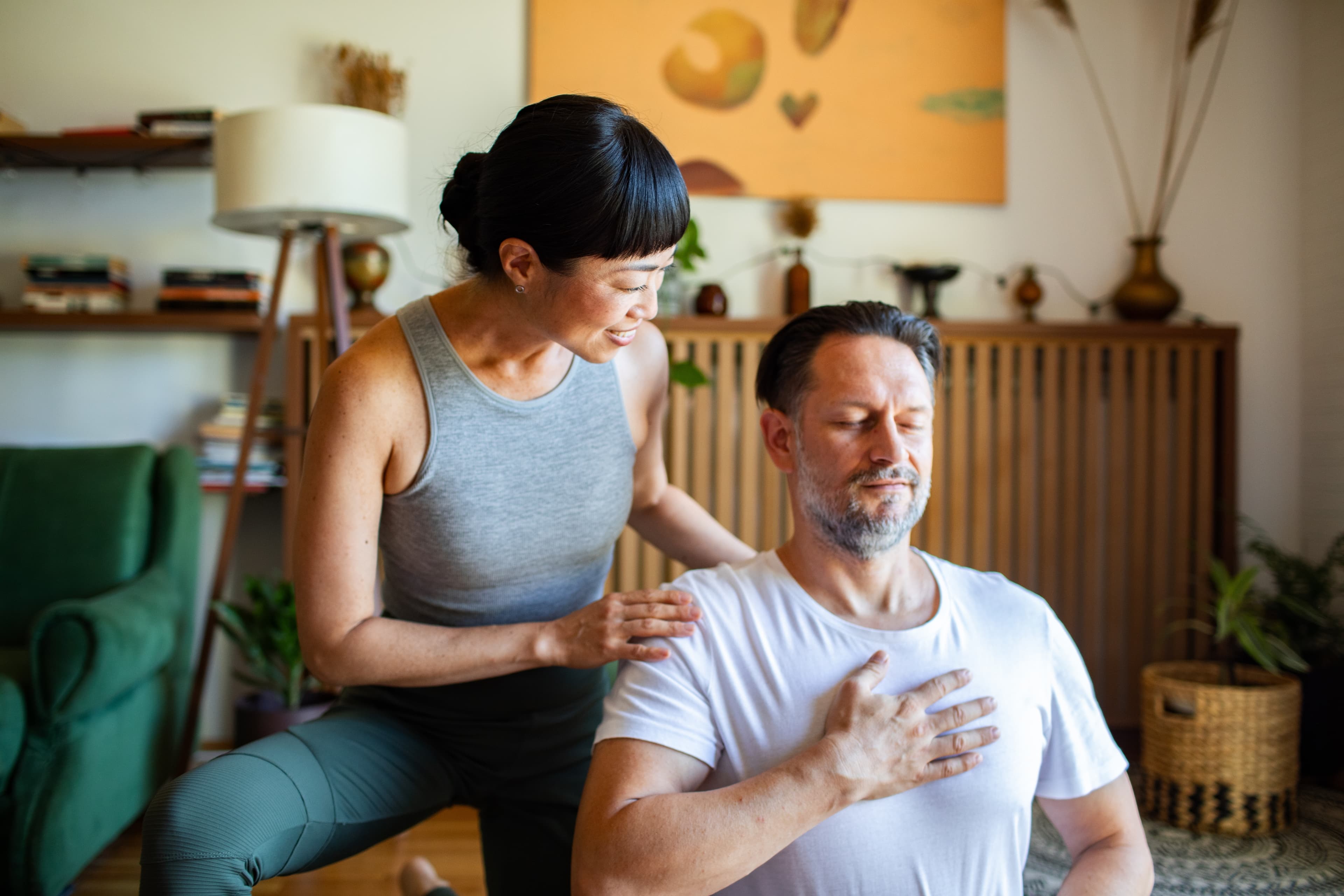
Holistic kinesiology is a hands-on, table-based wellness practice that uses manual muscle testing as a biofeedback tool. The practitioner places the client's arm or leg in a specific position and applies light pressure; the change in muscle response — the small ways the muscle either holds or yields — is read as feedback from the body's own information system. From that feedback the practitioner builds a session: balancing specific muscle-meridian pairs, addressing emotional stress patterns associated with specific points, and supporting the client toward a stated goal.
Holistic kinesiology should not be confused with academic kinesiology — the university-level study of human movement that prepares students for physical therapy or athletic training. The two share a name but are different fields. Holistic kinesiology grew out of George Goodheart's Applied Kinesiology in the 1960s and was popularized in non-medical wellness practice through John Thie's Touch for Health system in the 1970s. Today it is one of the most widely-practiced hands-on modalities in the U.S. wellness market.
The Kinesiology curriculum in Chicago: 9 in-person days.
Nine days, the full Touch for Health 1-4 synthesis, and a practice that's yours.
- Teaching days
- 9
- Teaching hours
- 72h
- Cohort size
- 10
days, 7h each
in the room
in your Chicago cohort
| Day | Theme |
|---|---|
| Chapter 1 · Days 1–2First touch | |
| 01 | Muscle testing and Touch for Health 1 begins |
| 02 | The 14-muscle balance |
| Chapter 2 · Days 3–4Deeper maps | |
| 03 | Touch for Health 2: 28 muscles and circuit locating |
| 04 | The meridian wheel and the five elements |
| Chapter 3 · Days 5–7The full system | |
| 05 | Touch for Health 3: 42 muscles and goal balancing |
| 06 | Reactive muscles, gait and easing discomfort |
| 07 | Touch for Health 4: standing, lying and postural stress |
| Chapter 4 · Days 8–9Your practice | |
| 08 | The full synthesis and your session arc |
| 09 | Your practice, your assessment, your CHKP |
Signature moment of the program
When Kinesiology cohorts run in Chicago.
Chicago cohorts adjust around the city's pronounced winter. Most students prefer May or September starts; January cohorts are smaller. Weather rarely cancels classes (Chicagoans are used to it), but the cohort schedule includes one snow-day buffer per month from November through March. The deep winter creates unusually strong cohort cohesion — the shared experience of trekking through January slush to attend training builds bonds that summer cohorts do not produce.
Who this Chicago cohort is for.
Bodyworkers, yoga teachers, and career-changers who want to add a powerful biofeedback tool to their work.
Where your Chicago training leads.
- Open a private Holistic Kinesiology practice (CHKP)
- Specialize in stress, goal balancing, or posture and movement wellness
- Add kinesiology to a yoga, coaching, or bodywork practice
- Lead small-group practitioner exchanges
$4,000 for the full 9-day Kinesiology program in Chicago.
Same tuition whether you study in Chicago or any of our other U.S. cities. Monthly payment plans without interest. A 25% deposit confirms your spot in the Chicago cohort.
Tuition and financing details$4,000
72h of teaching · 9 in-person days
Kinesiology: questions students ask first.
- Muscle Testing in Kinesiology: How It Works and What It Cannot ShowManual muscle testing is a binary feedback tool, lock or give, checked by 3 pre-tests. What the reflex does, what research shows, why we never test allergies.9 min read
- Kinesiology Certification: What the Training Actually CoversTwo different fields share the word kinesiology. Here is which one you have found, what muscle-testing training really teaches, and what it can never claim.10 min read
- What Is Kinesiology and How It Differs From Exercise ScienceOne word, two unrelated fields: a university movement-science degree and a hands-on practice built on muscle testing. Here is how to tell which one you found.10 min read
Kinesiology certification in other Harmonika cities.
Next step
Become a Certified Holistic Kinesiology Practitioner in Chicago.
Talk with our admissions team about the next Kinesiology cohort starting in Chicago, IL. Free, online, one hour.