Journal · Kinesiology · What it is
What Is Kinesiology and How It Differs From Exercise Science
One word, two unrelated fields: a university movement-science degree and a hands-on practice built on muscle testing. Here is how to tell which one you found.
Valérie Fabre, Founder & Director, Harmonika Institute · May 5, 2026 · 10 min read
Key takeaways
- Two fields share the word. In American universities, kinesiology means the science of human movement: biomechanics, exercise physiology, motor control. It is a four-year degree. It has no connection to the hands-on practice sold under the same name.
- The other kinesiology is about 60 years old. Applied Kinesiology was assembled by a chiropractor in 1964, and the softer offshoots people meet today, Touch for Health among them, date from the 1970s onward.
- Muscle testing does not survive blinding. When practitioners are tested against sealed or concealed samples, their accuracy drops to roughly what chance would produce. That result has repeated for decades.
- The session is still worth describing accurately. Sixty to ninety minutes, clothed, lying on a table, arm held out repeatedly. Most people find it calming and oddly conversational. That is a real experience, and it is not a diagnosis.
- Career paths diverge completely. One leads through a university degree toward strength coaching, athletic training, or physical therapy school. The other is private certification (ours runs 9 in-person teaching days, 63 teaching hours), no licence anywhere.
A woman in Denver told us she had spent three weeks reading about kinesiology programs before she realised she had been reading about two entirely different things. One page described force plates, VO2 max testing and a 120-credit bachelor's degree. The next described a practitioner holding her arm and asking her body questions. Same word. No relationship whatsoever. She is not the first person to lose three weeks that way.
So this article does the boring, useful job. Both fields, explained fairly, with enough detail that you can work out in about four minutes which one you were actually looking for. And because the second one rests almost entirely on a single technique, we spend real time on that technique, including the part where it performs badly under controlled conditions.
Two fields, one word, no shared root
Kinesiology comes from the Greek for movement. That is the only thing the two uses have in common.
Academic kinesiology is a mainstream science discipline taught in hundreds of U.S. universities. It studies how bodies move: the mechanics of a joint under load, how muscle tissue produces energy, how the nervous system learns a skill. Departments were often called Physical Education until the 1970s and 80s, when they renamed themselves to reflect a research-heavy curriculum. Nothing metaphysical about it.
Applied and specialised kinesiology is something else. It grew out of chiropractic in the mid-1960s, when Detroit chiropractor George Goodheart began using manual muscle tests not to measure strength but as a source of information about the rest of the body. John Thie, a colleague, simplified the system for lay use and published Touch for Health in 1973. From there it branched: Educational Kinesiology and Brain Gym in the 1980s, Health Kinesiology, Professional Kinesiology Practice, and a long tail of branded systems, each with its own founder and its own vocabulary.
If a program mentions credits, prerequisites and a laboratory, it is the first field. If it mentions balancing, meridians, or a personal lineage of teachers, it is the second.
What the university degree actually contains
A bachelor's in kinesiology or exercise science typically runs four years and covers anatomy, physiology, biomechanics, exercise prescription, motor learning, and usually a statistics and research-methods sequence. Many programs require a supervised internship. Most sit inside a college of health sciences.
Graduates rarely stop there. The degree functions as a foundation for something else: prerequisites for physical therapy or occupational therapy school, a route into athletic training, or a base for strength and conditioning certifications. People who stop at the bachelor's often work in corporate wellness, cardiac rehabilitation support roles, fitness management, or as personal trainers with more physiology behind them than most.
Worth knowing: the degree itself is not a licence to do anything clinical. Physical therapists are licensed in all fifty states and that requires a doctoral program. A kinesiology bachelor's alone puts you in the fitness and wellness workforce, not the clinical one, which surprises a fair number of undergraduates in their final year.
A quick sorting test
Look at what the program admits you to. If enrolment requires a high-school transcript, financial aid paperwork and a course catalogue with numbered prerequisites, you are looking at academic kinesiology. If you can enrol by filling a short form and paying a deposit, and the calendar is measured in weekends or months rather than semesters, you are looking at the practitioner field. Neither answer is a verdict on quality. They are simply different objects.
What the practitioner field is doing
Strip away the branded systems and the shared premise is this: the responsiveness of a muscle when lightly challenged reflects something about the state of the person as a whole, and can therefore be used as a kind of feedback channel. Stress, food sensitivity, an unhelpful belief, a structural imbalance. The practitioner poses a question, applies gentle pressure to your outstretched arm, and reads the arm's response as an answer.
What follows the test varies enormously by system. It might be acupressure holding points, lymphatic rubbing points, a specific eye movement, a nutritional suggestion, an emotional-stress-release hold on the forehead, or a short piece of coaching conversation. The word most systems use for the whole procedure is a balance.
Two things need saying plainly here. First, this is not physical therapy and is not a substitute for it. Second, manual muscle testing does exist in legitimate clinical assessment, graded on a standard nought-to-five scale, and it is a reasonable way to measure whether a muscle is weak. Nobody disputes that. What is disputed is the inferential leap: from a muscle yielding under pressure, to a conclusion about a food, an organ, or a memory.
What actually happens in a session
You keep your clothes on. Shoes usually come off. Most sessions run 60 to 90 minutes, and the first one is longer because of intake questions.
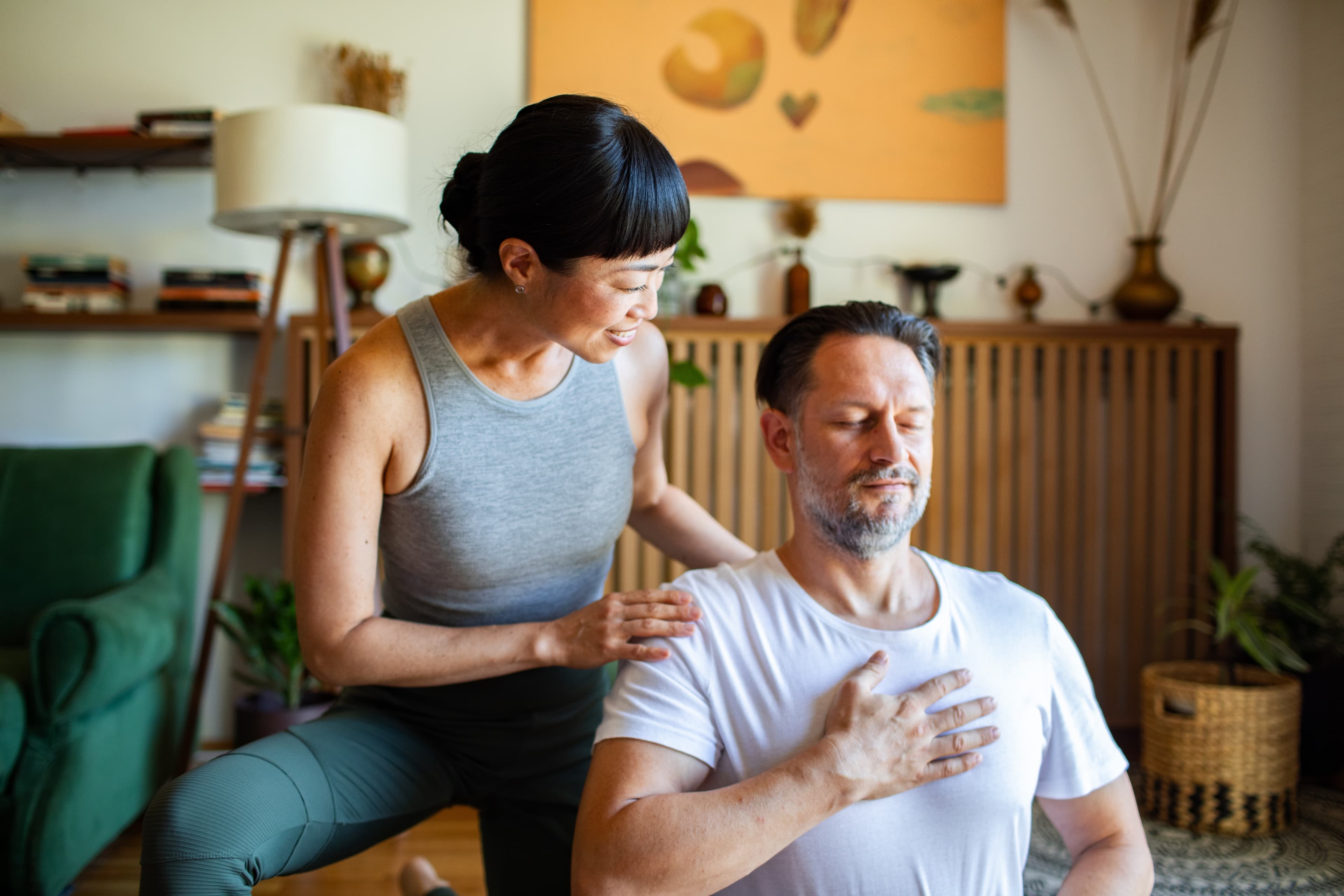
You lie on a padded table, face up. The practitioner asks you to hold one arm straight up or out to the side, then presses down on your wrist or forearm for a second or two while you resist. Not hard. The pressure is closer to what it takes to close a stiff drawer than to arm-wrestling. They will do this many times, often while you hold a thought, say a sentence out loud, or hold a small vial against your body.
Between tests they may touch specific points on your head, ribs, or feet, ask you to breathe in a particular pattern, or have you look in a direction while thinking of something. Expect questions about sleep, stress and life circumstances throughout, which is a large part of why people report the hour as unusually attentive.
Common reactions afterwards: tiredness, thirst, a flat calm, occasionally a lift in mood. Some people feel nothing at all. Practitioners often suggest drinking water and taking the evening gently. There is no medical mechanism established for any of that, and a practitioner who tells you a balance has treated a condition is out of bounds, both factually and legally.
Muscle testing under controlled conditions
What the evidence shows
The core claim has been tested repeatedly since the 1980s, usually the same way: give practitioners concealed substances, or samples in identical opaque containers, and see whether their muscle responses identify them. Results cluster around chance. Studies that blind neither the practitioner nor the client tend to produce impressive results; studies that blind both tend not to. Agreement between two practitioners testing the same person on the same question is also weak.
Reviews of the applied kinesiology literature have concluded that the published research does not support its use as a diagnostic tool, and that much of the supportive work is methodologically poor. That is a settled picture, not a controversial one.
Notice what the finding is and is not. It is not that the arm never gets weaker. Something measurable does happen, and expectation, attention and small unconscious variations in how hard the practitioner presses are more than enough to produce it. That mechanism is known as the ideomotor effect, and it is the same one that moves a ouija planchette or a dowsing rod: real movement, generated below the level of intention by the person holding the thing.
So the honest summary reads: the test detects something about the interaction between two people in a room. It has not been shown to detect anything about food, organs, deficiencies or hidden memories.
Why people keep going anyway
Because the hour delivers things that have nothing to do with diagnostic accuracy, and it is worth naming them rather than pretending the whole thing is empty.
A client gets ninety minutes of undivided attention from someone who asks careful questions and does not interrupt. They get a structured way to voice something they have not said out loud. And the ritual, the table, the repeated arm, the quiet, produces genuine physiological settling in most people.
None of that requires the muscle test to be an information channel. It does explain why clients come back and why practitioners believe in what they do. The problem is not that people find value here. It is when the framing slides into diagnosis, or when someone delays a medical appointment because a balance suggested it was a food issue. That is the harm, and it is not hypothetical.
Where the line sits
No U.S. state licenses kinesiology practitioners in the muscle-testing sense, which means there is no board, no protected title and no complaints process. Practitioners must not diagnose, must not tell you to stop or change a prescribed medication, and must not present a session as treatment for a condition. Hands-on soft-tissue work for compensation can fall under massage licensure in many states, so a practitioner who moves beyond light contact into actual bodywork may need a massage licence.
Rules differ by state and change. If you are considering practising rather than receiving, confirm your own position with the relevant state board first.
Which one were you looking for
| Academic kinesiology | Applied / specialised kinesiology | |
|---|---|---|
| Origin | Physical education departments, renamed from the 1970s | Chiropractic, from 1964 onward |
| Core method | Measurement of movement, force and physiology | Manual muscle testing used as feedback |
| Where you learn it | University, 4 years, ~120 credits | Private school, weekends to 10 months |
| Typical U.S. cost | $40,000-$100,000+ for the degree | $1,500-$9,000 across a full practitioner track |
| Licensed? | Degree is not a licence | No state licenses it |
| Evidence base | Mainstream science | Poor for diagnostic claims |
| Common next step | PT or OT school, athletic training, strength coaching | Private practice, often alongside another modality |
| Who it suits | People who want a credential institutions recognise | People who want a client-facing practice quickly |
If your interest is anatomy, sport, rehabilitation science, or working inside a hospital or a college athletics department, the university route is the one. Everything below assumes you landed on the other side.
If you are thinking about training rather than booking
The honest number
Introductory weekends in this field commonly run $250 to $600. A full practitioner track across several modules typically lands somewhere between $1,500 and $9,000 depending on hours and supervision. The spread has almost nothing to do with the techniques taught, which are broadly similar everywhere. It reflects how many supervised sessions you deliver on people who are not your classmates. Ask that number before you ask the price.
The uncomfortable question for anyone entering this field is how you will describe your work to a sceptical client without either overclaiming or losing your nerve. Our position is that you describe the session, never a mechanism and never an outcome: a structured hour, attention, physical settling, and a conversation the client largely directs. Practitioners who can say that plainly last. Practitioners who have only ever heard the true-believer version tend to fold the first time a nurse asks them a direct question.
If you want the training side in detail, including module structure and what a practitioner track covers week by week, we have written that up separately in what kinesiology certification actually covers. The program page lists cities and format.
Questions on this topic.
Is a kinesiologist a doctor?+
No, in either sense of the word. Someone with a university kinesiology degree holds an academic qualification, not a clinical licence, and cannot diagnose or treat. Someone certified in applied or specialised kinesiology holds a private certificate with no state recognition at all. If a person offering muscle-testing sessions uses a medical-sounding title or implies they can diagnose you, treat that as a reason to leave rather than a reassurance.
Can muscle testing detect food allergies or intolerances?+
It has not been shown to. This specific claim has been tested more than most, usually by presenting practitioners with concealed samples, and the results generally sit at chance level. If you suspect a food allergy, that is a question for a physician who can run validated testing, because genuine allergy carries real risk. Cutting foods out of your diet on the basis of a muscle test can leave you with a narrower diet and the original problem still there.
Why did my arm actually go weak, then?+
Most likely the ideomotor effect: small, unconscious movements produced by expectation rather than intention, in you, in the practitioner, or both. Pressure applied a fraction harder or at a slightly different angle changes the result, and neither party notices. This is not an accusation of dishonesty. It is a well-documented feature of how human bodies behave when someone expects a particular outcome, and it is exactly why blinding matters in testing.
Should I tell my doctor I am seeing a kinesiology practitioner?+
Yes, particularly if any supplement or dietary change has been suggested. Supplements interact with prescribed medication more often than people assume. A good practitioner will encourage you to keep your physician informed and will never suggest changing a prescription. Anyone who advises you to keep a session secret from your doctor, or to postpone a medical appointment, has crossed a line you should take seriously.
Is Brain Gym the same thing?+
It comes from the same family. Educational Kinesiology, marketed as Brain Gym, applies the muscle-testing framework to learning, using movement sequences said to improve concentration and reading. It reached a lot of schools in the 1990s and 2000s and drew sustained criticism from neuroscientists over the explanations attached to the exercises. Children moving around during a lesson may well help them focus. The neurological rationale offered for it is the contested part.
Which one do employers mean on a job listing?+
Almost always the academic one. A U.S. job posting asking for a kinesiology background is looking for exercise science: a degree, an internship, often a strength and conditioning or personal training certification on top. Practitioner-level muscle-testing certificates rarely appear in employed roles at all, because that work is nearly always self-employed and client-facing. If a listing is ambiguous, the required credential line will tell you within seconds.
Tags:
KinesiologyWhat it is
About the author
Valérie Fabre · Founder & Director, Harmonika Institute
Valérie Fabre founded Harmonika Institute in 2025, after a decade seeing clients in private kinesiology practice and, before that, thirteen years in international trade. A French-born polyglot who now splits her time between Dallas and Miami, she sets the school's curriculum and editorial standards and champions ethical, in-person training.
Read more about Valérie Fabre →