Journal · Reflexology · Training near you
Reflexology Classes Near Me: What In-Person Training Requires
How to tell a spa upsell weekend from professional reflexology training, why credible programs are long, and the state question to settle before you pay.
Valérie Fabre, Founder & Director, Harmonika Institute · June 17, 2026 · 10 min read
Key takeaways
- Pressure is the whole skill, and it cannot be taught remotely. The difference between useful and useless work on a foot is a few pounds of force and a change of angle. Someone has to watch your thumb and tell you.
- Serious programs run 200 to 300 hours. Widely used voluntary standards in the U.S. sit around the 200-hour mark plus documented sessions. A 16-hour weekend is not that, whatever the certificate says.
- Your state question comes before your school question. Some states regulate reflexology directly, some fold it into massage licensure, some leave it alone. Settle which one you live in first, because it changes what training you need.
- The spa upsell course is the main trap. If the listing sells product knowledge, a treatment menu, and a same-day certificate, you are buying a retail training day, not a profession.
- Documented hours on strangers are the real credential. Fifty or sixty logged sessions on people who are not your classmates is what separates someone who knows the foot map from someone who can hold a session.
Type "reflexology classes near me" and your results will be a mess of three unrelated things: a day spa selling a 90-minute foot session, a wellness shop running a $149 Saturday workshop with a certificate at the end, and somewhere further down, an actual training program that takes months and expects you to log practice hours. Google cannot tell these apart. The first two spend money to be at the top. This article is about telling them apart yourself, and about what genuine in-person reflexology training actually asks of you.
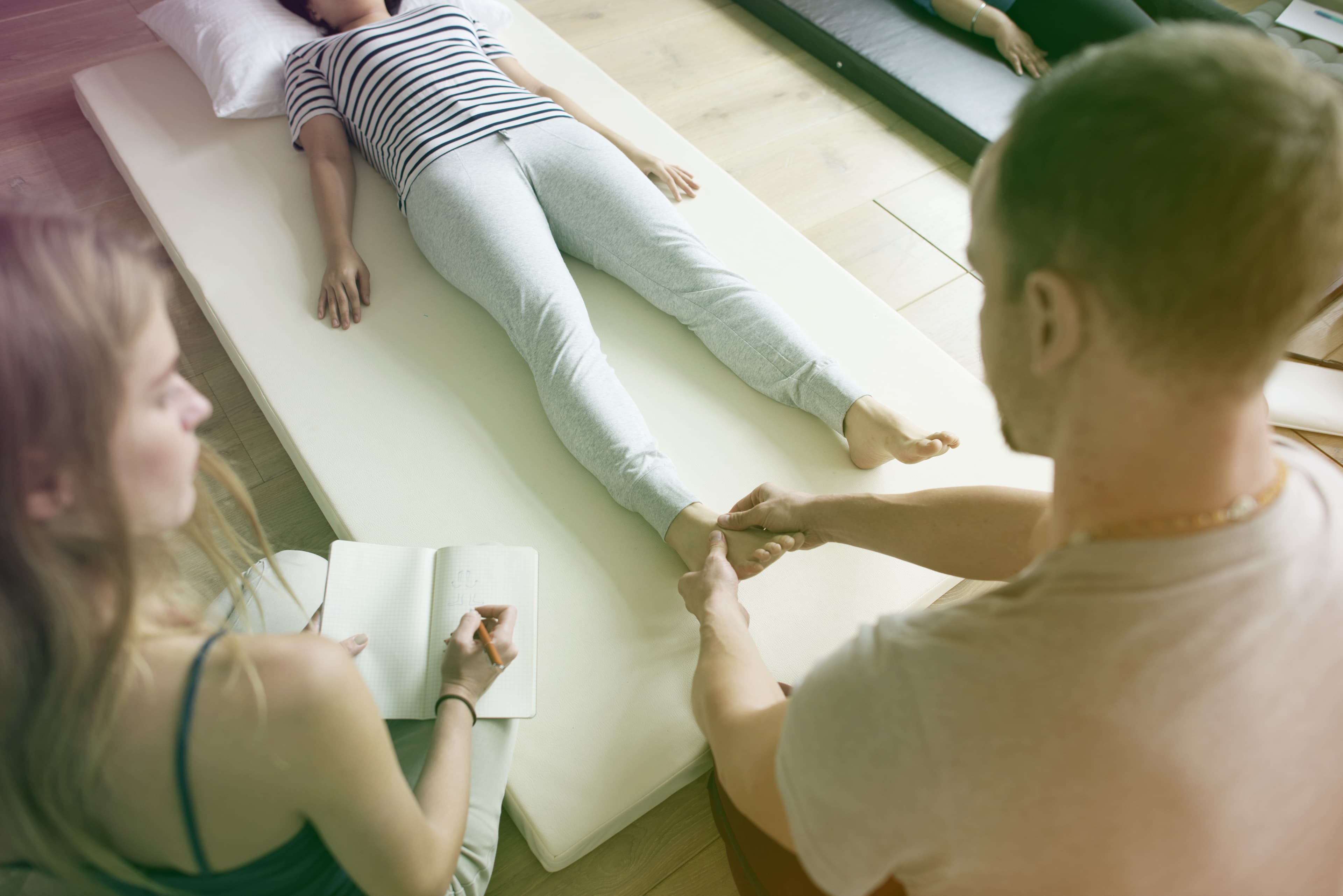
The reason the in-person argument is stronger for reflexology than for almost any other modality in our catalogue comes down to one physical fact. You cannot calibrate pressure without a foot in your hands and an experienced person watching what you do to it.
Why the hands-on requirement is not a marketing line
Here is what a first-week student actually gets wrong. They press with the pad of the thumb instead of the medial edge, so the force spreads and nothing lands. They flex the wrist to generate force instead of leaning body weight through a stacked arm, so their thumb joint is inflamed by session four. They work at a constant depth across a whole foot, when the plantar surface under the ball tolerates far more than the tissue over the dorsal bones. They hold their breath. They lose contact between points, which the client feels as a series of pokes rather than a session.
Every one of those errors is invisible on video and invisible to the student. You do not know your wrist is flexed. You do not know your pressure dropped by half in the last ten minutes because your hands got tired. Someone standing beside you says "stack your elbow over it" and puts two fingers on your forearm, and the correction takes four seconds. Then it has to happen again, on a different foot, maybe forty times before it becomes yours.
There is a second thing a screen cannot give you: feet that are not yours. A wide flat foot with heavy callus, a narrow high-arched foot, a diabetic foot with reduced sensation, an eighty-year-old foot with hallux valgus, a runner's foot with a hot spot under the second metatarsal head. Each takes a different amount of force to reach the same depth. You learn that range by touching maybe sixty different pairs, not by touching your own.
From the training floor
Ask any program this: "How many hours will I have my hands on a foot that does not belong to a classmate?" Not contact hours. Not lecture hours. Hours of supervised work on outside bodies. Many programs cannot answer, and the ones that hesitate are telling you something. It is also the single question that separates a 200-hour curriculum with 30 real hours in it from one with 120.
The three things you will find when you search
Sort every local result into one of three buckets before you read another word of its sales page.
| What you found | Typical format | Typical U.S. price | What you leave with | Professional track? |
|---|---|---|---|---|
| Client session at a spa or studio | 45-90 minutes, you on the chair | $60-$130 | An experience, and a sense of whether you like the work | No |
| Introductory or self-care workshop | 3-8 hours, one day | $75-$300 | A foot map handout, a few techniques for family, a certificate of attendance | No |
| Spa or retail "certification" day | 8-16 hours, often product-linked | $150-$600 | A certificate that looks professional and is not | Marketed as one |
| Professional training program | 150-300 hours over 4-10 months, plus logged sessions | $2,500-$7,000 | Anatomy, pathology awareness, contraindications, documented practice, a defensible credential | Yes |
| Massage school reflexology module | Add-on inside a licensure program | Varies with the parent program | Reflexology as a technique inside a licensed scope | Yes, if you want the licence |
The third row is the one that costs people money. A retail day taught by a product brand can be genuinely well delivered and still be the wrong purchase, because the certificate is not built to survive a question from an insurer, a landlord, or a state board. You can spot it from the listing: it emphasises what you will be able to offer clients by Monday, it bundles a product kit, and it never mentions logged practice hours or a written examination.
Settle the state question before you settle the school
This is where reflexology differs sharply from Reiki or sound work. Reflexology involves sustained manual pressure on soft tissue for compensation, which is the definition many state massage acts were written around. So the regulatory picture is genuinely mixed, and it decides what your training needs to be.
Broadly, states fall into three categories. Some have created a distinct reflexology credential or registration, recognising it as its own practice with its own hour requirement. Some define massage broadly enough that reflexology for pay falls inside massage licensure unless a specific exemption applies. And some do not regulate it at all at state level, though a city or county may still license the establishment you work in.
Check your state first
Call or email your state massage board and ask two specific questions. First: does practising reflexology for compensation in this state require a massage licence, or is there an exemption or separate registration? Second: if there is an hour requirement, how many hours and from what kind of provider? Get the answer in writing, keep it, and re-check it before you renew anything. These rules change, and a school's website is not a legal source. We map the categories in more detail in our state credentialing map and in the certification guide.
Separately: reflexology is not a medical treatment. You do not diagnose, you do not treat named conditions, and you do not tell someone their liver reflex means anything about their liver. That framing is both the legally safe one and the honest one.
Why this comes first: if you live in a state that folds reflexology into massage licensure, a 200-hour private certification will not by itself let you charge for the work. You may need a licensure-track program instead, or a different plan. Finding that out after you have paid tuition is a bad afternoon.
Why credible programs are long
People assume the hours go into memorising the foot maps. They do not. The maps take a couple of days, and you will still be checking them at month three.
The hours go into everything around the maps.
- 1
Anatomy that matters to your thumbs
Bones, arches, plantar fascia, the major nerve paths, and enough dermatology to recognise something you should not be working on. Perhaps 30 to 50 hours.
- 2
Contraindications and referral
Acute DVT risk, unexplained calf pain and swelling, cellulitis, open lesions, recent fracture, uncontrolled diabetes with neuropathy, late pregnancy considerations. Knowing when to stop and say "see a doctor before I work on this" is a taught competence, not instinct.
- 3
Technique drilling under correction
The largest block. Thumb-walking, finger-walking, hook and back-up, rotation on a point, holding depth for a full sequence without your force decaying. This is the part that only works in a room.
- 4
Documented practice sessions
Commonly 50 to 100 logged sessions on outside bodies, written up. This is where you learn that people cry, that some feet are ticklish enough to make a full session impossible, and that your beautiful 60-minute sequence runs to 85 when you are nervous.
- 5
Session craft and the business
Intake forms, consent, notes, hygiene protocol, room setup, pricing, and what you say when a client asks whether this will fix their migraines.
What the evidence shows
Research on reflexology is uneven. The better-conducted trials cluster around anxiety, fatigue, and comfort in settings like oncology support and post-operative care, and they tend to report modest improvements in self-reported measures. Trials testing the specific claim that pressing a defined zone affects the corresponding organ are much weaker, and reviews consistently flag small samples and blinding problems.
So the defensible statement is narrow: people frequently report feeling calmer and sleeping better after sessions. The zone-to-organ mechanism is a traditional framework, not a demonstrated one. A program that teaches you to say the second sentence out loud is training you properly.
Reading a local listing in ninety seconds
You do not need to phone every school. Four things in the listing usually settle it.
Total hours, stated as a number. If the page tells you the program is "flexible" or "self-paced with a practical day", the hours are low and they know it. Serious programs lead with the number because it is their selling point.
An assessment you could fail. Written exam plus a practical assessment observed by an instructor. If the only requirement is attendance, the certificate certifies attendance.
A named practice-hour requirement. Logged sessions on people outside the cohort, submitted and reviewed. Its absence is disqualifying at the professional tier.
Class size. This is the quiet one. Pressure correction is one-to-one work. In a room of twenty-four students with one instructor, you will be corrected perhaps twice a day. We cap cohorts at ten for exactly this reason, and it is why our reflexology track runs in person across our 32 U.S. cities rather than on a screen.
What "near me" really costs you in time
In-person training has a commute, and people underestimate it. A cohort meeting one weekend a month for eight months is sixteen days, plus travel on either side, plus the practice sessions you arrange yourself in between. If you are in one of the larger markets like Los Angeles or Houston, a 40-minute drive each way is normal, and it is a real 25 hours of your life across the program.
The trade is worth naming honestly. You lose those hours. What you get back is a room of nine other people in your own city who watch you work for months, half of whom will still be sending you referrals in year three. That local cohort is the most underrated asset in the whole model, and it is the thing a distance program structurally cannot produce.
Budget past tuition
Across the U.S. market, a professional-tier reflexology program commonly lands somewhere between $2,500 and $7,000. Then add the parts nobody quotes: a portable chair or table if you plan to travel to clients, linens and hygiene supplies, professional liability insurance, any state or city registration fee, and the income you are not earning during training weekends. Assume the true figure is 20 to 30 percent above the tuition line.
Who this work actually suits
Reflexology rewards people who like repetitive, precise, physically quiet work and who are comfortable with an hour of low conversation. Overhead is modest, a session is easy to deliver in a shared suite or a corner of someone else's studio, and older clients accept a foot session far more readily than they accept anything described as energy work.
It suits you less if your hands are already compromised. Thumb and wrist strain is the occupational injury of this field, and practitioners who work through it end up shortening their careers. A good program teaches body mechanics as a safety subject from week one, and asks you honestly about any existing joint problems before you enrol.
Questions on this topic.
Can I take one weekend class near me and start charging for sessions?+
In some states nothing stops you legally, and in others it is straightforwardly unlawful without a massage licence or reflexology registration. Even where it is permitted, it is a bad idea. After 16 hours you have a foot map and no calibration, no contraindication training, and no idea what to do when someone's calf is warm and swollen. Insurers also read hour counts, and a weekend certificate is frequently not enough to be covered.
How do I check whether a local school is legitimate?+
Ask for total hours, the practice-hour requirement, the assessment method, the instructor's own client caseload, and the student-to-instructor ratio in practical sessions. Then ask for two graduates from the last two years you can contact. A school with a real track record will connect you within a day. One that deflects is answering the question.
Is reflexology training the same as a massage licence?+
No, and conflating them is the most expensive mistake in this area. A massage licence is a state credential with statutory hour requirements and an exam. Reflexology certification is private, unless your state has created its own registration. In several states you need the massage licence to do reflexology for pay at all. Confirm with your board rather than with a school.
Do I need to be able to name every zone on the foot to start?+
No. Every credible program teaches the maps from scratch, and students who arrive having memorised a chart from a book often have to unlearn a version of it. What helps far more before you start is having received several sessions from different practitioners, so you know what varying pressure feels like from the receiving end.
What can I honestly tell clients reflexology does?+
Describe the session and the commonly reported experience, not a mechanism and not an outcome. That it is a structured pressure sequence on the feet, that most people report feeling calmer and often sleep better that night, and that it is not a treatment for any medical condition and does not replace medical care. Avoid the words treat, cure, heal, and detox entirely.
Are there classes near me if I do not live in a major city?+
Fewer, and this is a real constraint of in-person training. Most professional programs in the U.S. concentrate in larger metros, so people in smaller markets travel and cluster their weekends. Our own cohorts run across 32 cities including New York, Chicago, Miami, Boston, Atlanta, Seattle, Denver and Austin, and a fair share of students drive in from two or three hours out.
Tags:
ReflexologyTraining near you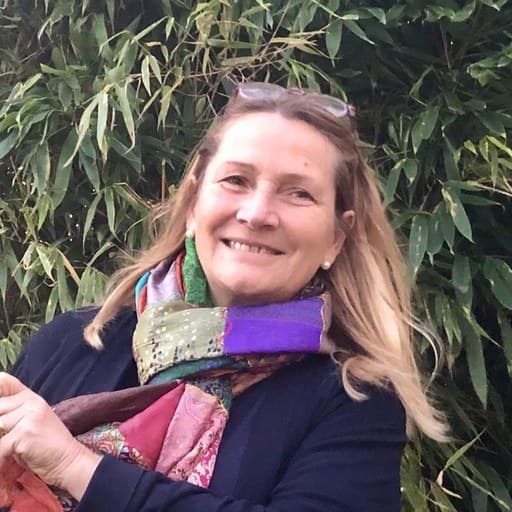
About the author
Valérie Fabre · Founder & Director, Harmonika Institute
Valérie Fabre founded Harmonika Institute in 2025, after a decade seeing clients in private kinesiology practice and, before that, thirteen years in international trade. A French-born polyglot who now splits her time between Dallas and Miami, she sets the school's curriculum and editorial standards and champions ethical, in-person training.
Read more about Valérie Fabre →