Journal · Reflexology · Choosing a program
Foot Reflexology vs Massage: What You Can and Cannot Claim
Reflexology and massage are different regulated activities in most U.S. states, and the wrong sentence on your website can move you across that line.
Valérie Fabre, Founder & Director, Harmonika Institute · July 6, 2026 · 10 min read
Key takeaways
- The difference is technical, and the law reads it literally. Reflexology applies specific pressure to reflex zones on the feet, hands and ears, usually with the client clothed apart from shoes and socks. Massage manipulates soft tissue for the sake of the tissue. Boards look at what you do and what you say you do.
- Your website is the evidence. In most complaints that reach a massage board, nobody watched the session. They read the practitioner's own words: "muscle tension release", "deep tissue", "therapeutic massage". Three phrases, and the file opens.
- Four categories of state approach, not fifty answers. Some states register reflexology in its own right, some exempt it from massage licensure by name, some fold it inside the massage act, and some say nothing at all. Silence is the most dangerous of the four, not the safest.
- Working above the ankle is where most people slip. A calf rub as a courtesy at the end of a session is soft-tissue work for compensation. It takes about forty seconds and it changes what you were doing.
- The safe vocabulary is smaller than you'd like and it still sells. Describe zones, pressure, relaxation and the experience. Do not describe muscles, conditions, treatment or results. Clients book anyway.
A reflexologist in a state that licenses massage broadly writes six words on her booking page: "deep relaxation and muscle tension release." She has never touched a shoulder in her life. She works feet, over a chair, forty-five minutes, clothed client. But a competitor reads the page, files a complaint, and the board's question is not what she does. It's what she advertised. That sentence took her nine months and a lawyer to resolve.
This article is about the line between reflexology and massage, and specifically about the language that puts you on the wrong side of it. It is not a technique comparison. If you want to know what reflexology feels like or how the foot maps are supposed to work, that's a different piece. This one is about what you may say, in writing, for money.
What actually separates the two practices
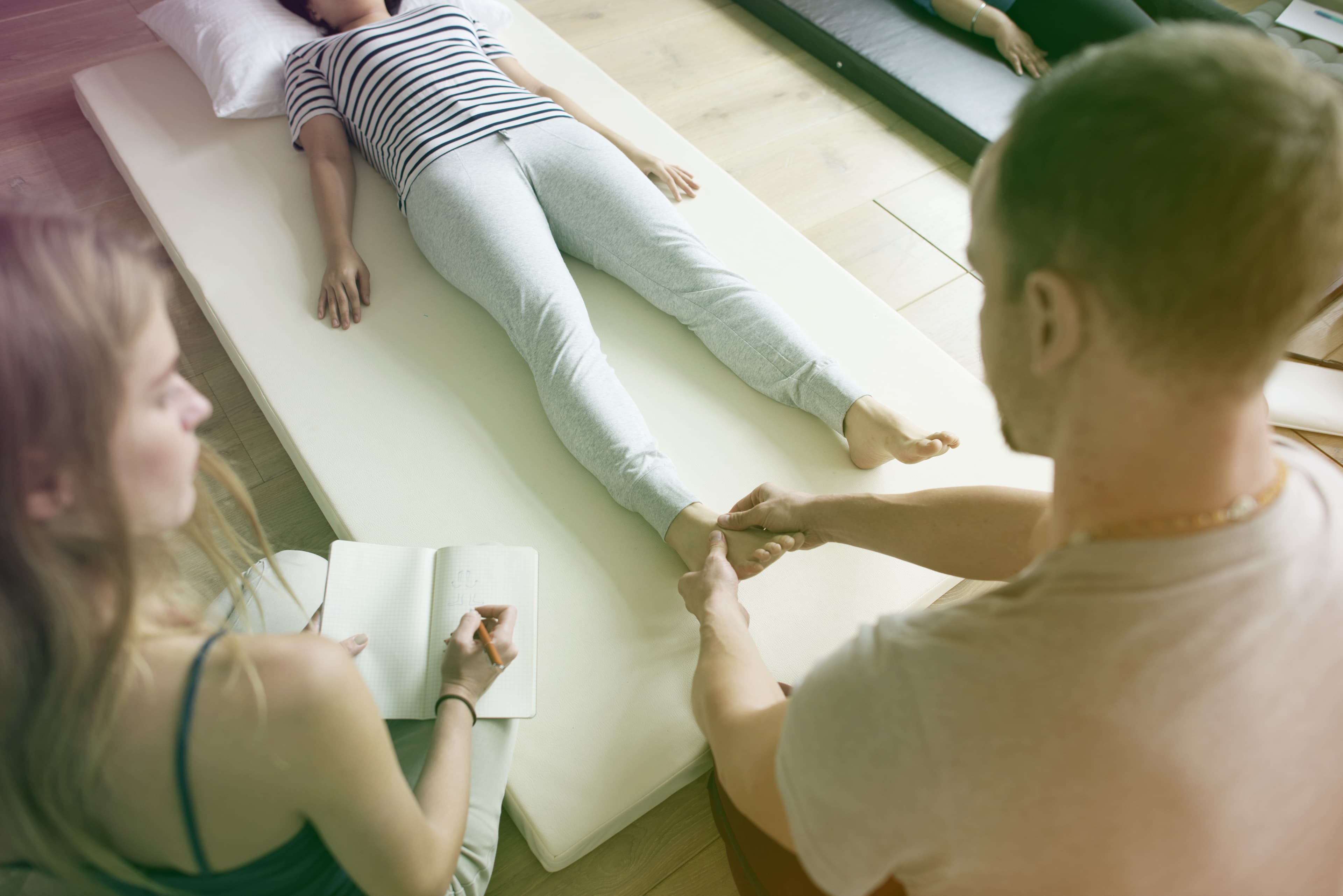
Reflexology is a pressure technique applied to mapped zones, most commonly on the plantar and dorsal surfaces of the feet, and also on the hands and the ears. The practitioner uses thumb-walking, finger-walking and hooking motions against a reflex map. The client normally stays dressed, sits reclined or lies on a table, and only the feet or hands are uncovered. There is no oil in classical practice, no draping ritual, no work on the trunk or limbs.
Massage, in the definitions written into state practice acts, is the systematic manipulation of the soft tissues of the body. Kneading, effleurage, petrissage, friction, stretching. The purpose is the tissue itself: circulation, adhesion, tone, range of motion. Most acts also fold in the use of lubricants, heat, and mechanical devices applied to soft tissue.
Read those two paragraphs again and notice something. The distinction is not "gentle versus firm" and it is not "feet versus body". Reflexology pressure can be genuinely intense; plenty of clients wince. The distinction is what the pressure is aimed at. Reflexology aims at a zone that is held to correspond to something elsewhere. Massage aims at the tissue under the hand.
That is a philosophical distinction doing legal work, which is exactly why it's fragile. A regulator cannot see intent. They can see your intake form, your session notes, your price list and your homepage.
Why this is load-bearing
In the states that license massage, practising massage for compensation without a licence is typically an unlicensed-practice offence, not a paperwork problem. Consequences range from a cease-and-desist letter to fines and, in some jurisdictions, misdemeanour charges. Reflexology done and described as reflexology may sit outside that definition. Reflexology described as massage does not, regardless of what your hands did.
Rules differ by state and city and they change. Verify your own situation with your state's massage board or health department before you take a paying client.
Four ways states handle it
There is no national answer, and any site that hands you a tidy fifty-state table is selling confidence it cannot back. What you can learn quickly is which of four categories your state falls into, and that determines what you do next.
Category one: reflexology regulated on its own terms
A small number of states have written reflexology into statute separately, with their own registration or certification requirement, defined training hours, and a scope that explicitly excludes soft-tissue work. This is the friendliest arrangement even though it costs money and paperwork, because the boundary is written down. You know exactly what you may do.
Category two: named exemption from the massage act
Several states license massage broadly but carve reflexology out by name, sometimes with conditions attached: work confined to feet, hands and ears; client clothed; no lubricants; no work above a defined point on the leg. Read the conditions with a pen in your hand. The exemption often has a hinge in it, and the hinge is usually the ankle.
Category three: swept inside the massage definition
Some states define massage widely enough that manual pressure applied to any part of the body for compensation falls within it, with no reflexology carve-out. In those states the honest answer is that you likely need the massage licence to charge for hands-on foot work, and no private certification substitutes for it. That is an unwelcome answer and it is better to have it before you pay tuition than after.
Category four: silence
Some states have no massage licensure at all, or a licensure scheme that simply never mentions reflexology. New practitioners read silence as permission. Boards read it as an open question, and municipal ordinances often fill the gap, licensing "massage establishments" in language that catches a foot-care studio without anyone intending it. Silence means check your city as well as your state.
Ask the board directly
Call or email your state massage board with one question, in writing: "Does the practice act apply to non-lubricated manual pressure applied to the feet, hands and ears of a clothed client for compensation?" Keep the reply. Practitioners who did this have a document; practitioners who asked in a Facebook group have an opinion from a stranger in another state.
The language table: what to say instead
Below is the part worth printing. Each row is a claim practitioners genuinely want to make, an assessment of whether it is safe to publish, and a replacement that says roughly the same commercial thing without moving you inside a regulated definition or a medical one.
| What you want to say | Safe? | Write this instead |
|---|---|---|
| "Therapeutic massage for tired feet" | No | "Reflexology sessions for tired feet" |
| "Muscle tension release" | No | "A deeply relaxing hour, fully clothed" |
| "Bodywork" as your service category | Risky | "Reflexology" as the named service, on its own |
| "Deep tissue foot work" | No | "Firm pressure, adjusted to your tolerance" |
| "Improves circulation" | No | "Most clients describe warmth in the feet afterwards" |
| "Helps with plantar fasciitis / migraines / anxiety" | No | Say nothing about conditions at all |
| "Detoxifies the body" | No | Drop it. There is no defensible version of this sentence |
| "Works reflex zones on the feet, hands and ears" | Yes | Keep as written |
| "You remain fully clothed apart from shoes and socks" | Yes | Keep, and put it high on the page |
| "A 50-minute session using thumb-walking pressure technique" | Yes | Keep. Specific, descriptive, claims nothing |
| "Complements the care you receive from your own providers" | Yes | Keep, if you never imply substitution |
Look at what the safe column has in common. It describes procedure and experience. It never describes anatomy you are acting on, and it never describes an outcome you are producing. That is the whole rule, compressed.
The word "bodywork" deserves its own paragraph
It's the most-used word in this corner of the field and one of the least useful. It has no fixed legal meaning, which practitioners hear as freedom and regulators hear as an umbrella that plainly includes soft-tissue manipulation. Several state acts define massage as including practices "however designated", precisely to stop people renaming their way out.
So the word doesn't protect you and it doesn't inform the client. Name the modality. "Reflexology" is a specific, defensible term with a defined technique behind it. Use it on your booking page, your signage, your invoices and your intake form, and use it consistently. Consistency is itself evidence.
Where practitioners actually cross the line
Rarely in a brochure. Usually in the last four minutes of a session, or in a friendly reply to a client email.
- 1
The courtesy calf rub
The session ends, the client mentions their calves are tight, and you oblige for a minute. That is soft-tissue manipulation of the lower leg for compensation. It is also the single most common informal boundary breach in the modality. Say "that's outside what I do, but I can recommend someone."
- 2
The shoulder squeeze on the way out
Same problem, less obvious, because it feels social rather than clinical. It is still hands on soft tissue during a paid appointment.
- 3
The condition conversation
A client asks whether reflexology will help their sciatica. Any answer other than "I can't speak to conditions, and that's a question for your own provider" moves you toward unlicensed practice of medicine, which is triggered by claims rather than by technique.
- 4
The review you didn't write
A grateful client posts that you "cured" their headaches, and you thank them publicly on a page you control. Testimonials on your own site are treated as your claims. Curate what you republish.
- 5
The oil
Reaching for lotion because the client's skin is dry. In several statutes the use of a lubricant on soft tissue is itself part of the massage definition, and the exemptions that mention it usually mention it as a prohibition.
On the reflex maps
Be careful here too, because overclaiming the theory is how the condition talk starts. Controlled research has not demonstrated that pressure on a mapped foot zone produces a specific effect in the organ it is said to correspond to, and reviews of reflexology for particular conditions have generally been small, heterogeneous and inconclusive. What is consistently reported is relaxation and reduced self-reported tension, which is a real thing to offer and needs no mechanism to defend.
Teach it as a traditional framework you work within, describe it as such to clients, and you will never have to retreat from a sentence.
If you want the wider permission, get the licence
Some people read all of the above and conclude that the safe version of the practice is too narrow for the practice they want. That is a legitimate conclusion, and the answer is not a cleverer choice of words.
If you want to work calves, backs and shoulders, use oil, and describe what you do in terms of muscles, then the massage licence is the instrument for that. It typically means several hundred hours at an approved school, a national exam in most states, and licensing fees. It is a real credential with real permissions attached, and it is not something a private certification can shortcut. We are direct about that because the alternative is watching people spend money on the wrong thing.
Plenty of people go the other way and stay narrow deliberately. Foot-focused practice has lower physical load, needs no table if you use a recliner, travels well for mobile work, and the clothed format removes a barrier for clients who would never book a table session. Working inside a tight scope is a business decision as much as a legal one, and it's often the better one.
The cost of guessing
Serious reflexology programmes in the U.S. commonly run 200 or more hours and land somewhere in the low-to-mid four figures; weekend spa courses run 16 hours and a few hundred dollars. Massage licensure is a separate track again, usually several hundred hours plus exam and licence fees. The expensive mistake is not picking the wrong tier. It's paying for any of them before establishing which category your state falls into, then discovering the certificate doesn't authorise the practice you planned.
What to fix on your site this week
Open your own booking page and read it as a regulator would, which means without generosity. Search the text for six words: massage, therapeutic, muscle, tissue, treat, and heal. Each hit is either removable or a decision you're making knowingly.
Then check your service names, your intake form, your invoice template and your directory listings, because directory profiles written three years ago outlive every website redesign. Practitioners clean up the homepage and leave a Yelp category set to "Massage" for another two years.
Finally, write one paragraph describing what you do, in plain language, with no claims in it, and use that same paragraph everywhere. When somebody asks what reflexology is, you'll have an answer that doesn't drift.
Questions on this topic.
Is reflexology just a foot massage?+
No, and the distinction is not marketing. A foot massage manipulates the soft tissue of the foot for the sake of that tissue, usually with oil or lotion. Reflexology applies structured pressure to mapped zones using specific thumb and finger techniques, without lubricant, with the client otherwise clothed. Clients often can't tell the difference from the outside, which is precisely why practitioners must be careful in how they describe the service. The words you publish, not the client's impression, are what a board reviews.
Can I add a little massage at the end of a reflexology session?+
If you don't hold a massage licence in a state that requires one, no. It feels like a kindness and it is legally a different activity. The exposure isn't theoretical either: it usually surfaces when a client mentions it in a review, or when they book elsewhere and say "my last person did my calves too." Decline warmly, explain your scope in one sentence, and keep the name of a licensed massage practitioner to refer to.
Do I need insurance if I only do reflexology?+
Yes, and getting it is also a useful test. Professional liability insurers write policies by named modality, and they will ask what your training was, how many hours it involved, and what you advertise. If an insurer hesitates over your programme or your wording, treat that as free early warning about how a regulator might read the same material. Insurers see complaint patterns across thousands of practitioners, and their questions reflect that.
What if my state has no massage licence at all?+
You still have two things to check. First, your city or county, which may license massage establishments independently and use a definition broad enough to include a foot studio. Second, your claims, since the prohibition on practising medicine without a licence applies everywhere and is triggered by what you promise rather than what you do. An unregulated state removes one constraint out of three.
Can a licensed massage practitioner just do reflexology as well?+
Generally yes, and it is one of the cleanest additions available to someone who already holds the licence, since the wider scope already covers the hands-on element. What the licence doesn't supply is competence in the technique, which is genuinely distinct: zone location, sustained thumb-walking, pressure calibration held for forty minutes. Many licensees add it as continuing education and find it extends their working life, because it loads the thumbs rather than the shoulders.
Tags:
ReflexologyChoosing a program
About the author
Valérie Fabre · Founder & Director, Harmonika Institute
Valérie Fabre founded Harmonika Institute in 2025, after a decade seeing clients in private kinesiology practice and, before that, thirteen years in international trade. A French-born polyglot who now splits her time between Dallas and Miami, she sets the school's curriculum and editorial standards and champions ethical, in-person training.
Read more about Valérie Fabre →