Journal · Reflexology · In-person training
Reflexology Certification Online: The Hands-On Problem
Why pressure is best graded in person, what online reflexology courses genuinely teach well, and how to check whether your state counts the hours.
Valérie Fabre, Founder & Director, Harmonika Institute · May 29, 2026 · 10 min read
Key takeaways
- Pressure is the whole skill, and it is hard to read on video. Two thumbs that look identical on camera can be delivering forces that differ by a factor of three. An instructor beside you can feel the difference; a screen rarely shows it.
- The hours may not count where you live. States that regulate reflexology commonly write their rules in terms of in-person contact hours. An online certificate can leave you holding a credential your own state does not recognise.
- Online is genuinely good at some of this. Zone theory, foot and lower-leg anatomy, contraindications, documentation, pricing, ethics. Roughly a third of a serious curriculum can live on a screen without loss.
- Price gap is real: about $200 to $700 online, $1,500 to $5,000 for in-person programs with observed practice. The difference buys observed practice hours, which is the only part that changes what your hands do.
- Feet are also where the massage licence question bites. Sustained soft-tissue work on a foot for money sits close to, and sometimes inside, the massage statutes in a number of states.
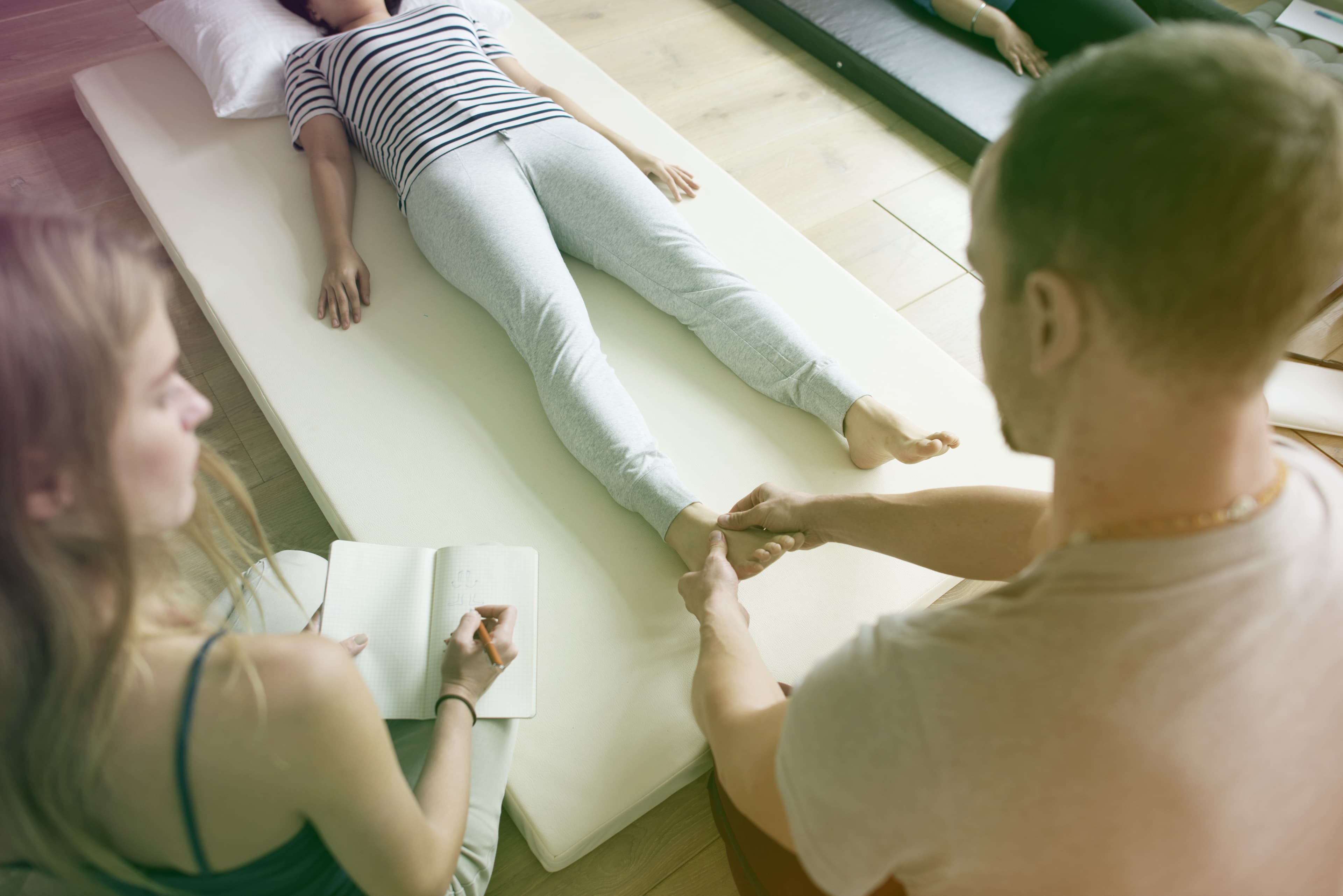
A reflexology instructor can stand three feet away, glance at a student's hand for two seconds, and say "too much, and you're pushing from your wrist." She isn't reading the screen of a laptop. She is reading the blanching around the student's thumbnail, the angle of the wrist, the small involuntary flinch in the client's calf, and the fact that the client's breathing just changed. Those signals live in the room. That is the specific reason we teach reflexology in person, and it's a narrower argument than the one usually made.
This is the clearest case in the whole online-versus-in-person debate, because reflexology's central competence is a physical quantity. Not a philosophy, not a rapport skill. A force, applied at an angle, sustained for a duration, adjusted in real time against a body that is telling you things you can only feel.
What the work actually is, mechanically
Strip away the maps and the charts for a moment. A reflexology session is a practitioner applying graded pressure to specific points on the feet, hands, or ears, usually with the thumb or the side of a bent index finger, moving in the small caterpillar motion most schools call thumb-walking.
That motion is harder than it sounds. The thumb flexes at the interphalangeal joint while maintaining constant contact and constant pressure, advancing perhaps a quarter of an inch at a time. Beginners do three things wrong, reliably. They lose contact between steps, so the client feels a series of pokes instead of a line. They drive from the wrist or shoulder rather than the thumb, which produces uneven force and destroys the practitioner's own joints inside two years. And they push far too hard, because pressing harder feels like working harder.
The last one is the big one. There is a band of pressure where the work does what it's meant to do, and it varies by client, by foot, by point, and by minute. Below it, nothing much registers. Above it, the client braces, the muscle guards, and you spend the rest of the session working against a foot that has decided to defend itself. Finding that band is not knowledge. It's calibration, and calibration is trained by correction.
From the training floor
A standard exercise: the instructor puts a bathroom scale under a student's thumb and asks for four pounds, then eight, then twelve. Almost nobody is accurate on the first pass. Most students overshoot by half again, and a few are so light they barely move the dial. After twenty minutes with feedback, most land within a pound. That correction loop takes seconds in a room. In a room the instructor has the scale, the foot and your hand within reach, which is what makes the loop work.
Four skills that are best learned in person
Being precise here matters more than being emphatic. The difference is specific: four transfers happen best with hands in the room.
1. Pressure calibration
Covered above. Worth adding that the feedback runs both directions: the student also needs to feel what a competent practitioner's four pounds feels like on their own foot, and to feel the difference between four and seven. Reflexology students spend a large share of their contact hours as the client, and that is not incidental. You are building a reference library in your own nervous system.
2. Reading tissue
Practitioners describe what they find under the thumb in terms like grainy, crunchy, ropey, spongy, hot. Whatever you believe those findings mean, and there's honest disagreement in the field, you cannot learn to identify them from a description. It's the same problem as learning to distinguish wine by reading tasting notes. A teacher who can put her thumb on the same spot thirty seconds after you did and say "that, right there, that's what I mean" is doing something no curriculum document replaces.
3. The client's non-verbal feedback
The foot flinches before the client says anything. Toes curl. The opposite leg tenses. Breathing goes shallow and high. A polite client will absolutely lie to you about pressure being fine while their whole body says otherwise. Learning to catch that and adjust before they say a word is a skill built by making the mistake with a real person in front of you and having someone point it out.
4. Your own body mechanics
Reflexology has a career-length attrition problem in the thumbs. Practitioners who work from the wrist and shoulder, or who lean into the table instead of using body weight through a stable frame, develop joint pain within a few years and quit. A webcam pointed at your hands rarely shows your seat height, your spinal position, or where your weight is going. An instructor circling the room sees all of it in a glance.
| Curriculum component | Share of a serious program | Works online? | Why |
|---|---|---|---|
| Zone theory, reflex maps, history | ~10% | Yes | Pure memorisation. Video and quizzes are arguably better than a lecture room. |
| Foot, ankle and lower-leg anatomy | ~15% | Yes | 3D models and animation beat a textbook. Palpation practice still needs a real foot. |
| Contraindications and safety screening | ~10% | Yes | Case-based and factual. Discussion boards handle it well. |
| Intake, documentation, scope language, ethics | ~10% | Partly | Frameworks online; role-play with a live person is where it sticks. |
| Technique acquisition (thumb-walking, holds, sequence) | ~25% | Best in person | Learned through correction of force, angle and contact by touch. |
| Observed practice on non-classmates | ~25% | Best in person | Learned with an observer in the room and a body that isn't yours. |
| Business setup and marketing | ~5% | Yes | Nothing here needs a room. |
Add up the green rows and you get somewhere near 40% of a curriculum that a good online provider can deliver honestly. That's not nothing. It's also why the strongest hybrid programs in this field put theory online deliberately and use the in-person days for nothing but hands and feedback, which is a better use of expensive contact time than sitting a cohort in a room to watch slides.
The regulatory problem, which people find out too late
Here is where an online certificate can become a genuinely expensive mistake rather than an incomplete education.
Reflexology sits in three broad regulatory categories in the United States. In some states it is unregulated outright, and nobody asks anything of you. In others, reflexology is folded into the massage statutes, so foot work for compensation requires a massage licence with the full hour requirement that implies. And in a third group, reflexology has its own certification or registration route, separate from massage, with its own hour requirement.
It is that third group that catches online graduates. When a state writes a reflexology-specific rule, it typically specifies a minimum number of hours and describes them as in-person or classroom contact hours, sometimes with a separate documented-session requirement on top. A self-paced course completed on a laptop does not satisfy that language, however many hours the certificate claims. Some boards will accept a portion of theory hours from distance learning and none of the practical hours. Others accept none at all.
Check before you pay
Call or email your state board and ask two questions in writing. First: does this state regulate reflexology separately, fold it into massage, or leave it alone? Second: if there is an hour requirement, does any distance or self-paced study count toward it, and toward which portion?
Get the answer in an email you can keep. Rules in this area differ by state and have changed repeatedly over the past decade, and a school's marketing page is not a legal source. Also check your city: a handful of municipalities license establishments where foot work happens, independently of state law.
There's a second-order version of the same problem. Even where the state is silent, the gatekeepers may not be. Professional liability insurers underwriting reflexology often ask about in-person practice hours. Spas, chiropractic offices and integrative clinics that hire reflexologists frequently ask where you trained and whether it was in person. A national voluntary certification exam, where you choose to sit one, will have its own eligibility rules about documented hours. None of those are laws. All of them are doors.
We've mapped the state categories in more detail in the reflexology certification rules guide, and there's a broader picture in the state credentialing map. Read one of them before you enrol anywhere, online or not.
What the price difference actually buys
The honest number
Online reflexology certificates in the U.S. market commonly run $200 to $700, occasionally under $100 on a discount platform. In-person programs with observed practice hours generally run $1,500 to $5,000 depending on hours and city. That's a real gap, and for someone paying out of pocket it is not a trivial one.
What the extra money buys is faculty time in the room with a small group. There is no way to make observed practice cheap, because it consumes an instructor's attention one student at a time. When a program is very cheap, that line item is the one that was removed.
Be fair about the cases where the cheap option is the right purchase. If you want to work on your own family, buy the online course. If you are a licensed massage therapist adding foot technique to an existing practice, where your hands are already calibrated and your body mechanics already sound, an online course plus a weekend workshop may be entirely sufficient. If you're testing whether the modality interests you before committing four figures, a $40 course is a cheap experiment and a sensible one.
What doesn't work is buying an online certificate as your route into paid practice and discovering, eighteen months later, that your hands are unreliable, your thumbs hurt, and your state wants hours you don't have.
How to evaluate any reflexology program, in five questions
- 1
How many hours will my hands be on a foot that isn't mine, with an instructor watching?
Not total hours. Not classroom hours. Observed hours. If the school can't give a number, that's the answer.
- 2
How many documented sessions on non-classmates before I certify?
Classmates are a poor test population. They're forgiving, they know the sequence, and they won't tell you the pressure was wrong.
- 3
What's the student-to-instructor ratio during practical work?
Correction doesn't scale. One instructor to twenty pairs means you get looked at twice an hour.
- 4
Will this satisfy my state's hour requirement, in writing?
Ask the school, then verify independently with the board. Schools are sometimes wrong about states they don't operate in.
- 5
Does the program teach body mechanics explicitly?
If nobody mentions your seat, your spine, or thumb protection, they are training you toward a five-year career.
Those questions work on us too. Reflexology is taught 100% in person at Harmonika, in cohorts of 10, over 9 teaching days of 8 hours (72 hours). Programs built on consultation and knowledge, such as Aromatherapy and Holistic Naturopathy, are taught 100% live online in cohorts of 15, in live weekend sessions. The full decision guide across modalities lives in the online versus in-person comparison.
One thing online does better
Access. If you live four hours from the nearest cohort city, have small children and a job with no flexibility, an online course is available to you and an in-person program is not. That's a real constraint and pretending otherwise would be dishonest.
Our answer is geographic rather than rhetorical: we run cohorts in 32 U.S. cities specifically to shorten that drive, with programs structured in blocks rather than weekly evenings so that travel happens a handful of times instead of thirty. It doesn't solve the problem for everyone. It solves it for more people than a single-campus model would.
Questions on this topic.
Is an online reflexology certification legitimate at all?+
It's a real certificate from a real provider, and the theory content is often decent. What it isn't is proof of competence with your hands, and in states with a reflexology-specific hour requirement it may not count toward registration. Think of it as coursework rather than as a qualification to practise. If you already hold a massage licence, the calculation is different and an online course can be a reasonable addition.
Can I do the theory online and the practical part in person?+
Yes, and this is the format we'd point people toward if they can't attend a fully in-person program. The caution is verifying which portion of hours your state accepts from distance learning before you pay for the online half. Some boards accept theory hours and no practical hours; some accept a capped percentage; some accept none. Get it in writing from the board, not from the school's FAQ page.
How many hours of training does reflexology actually require?+
Programs in the U.S. market commonly run from about 100 to 300 hours, with the practical share varying enormously between them. States with their own reflexology rules generally sit in the low-to-mid hundreds. The number that predicts whether you'll be any good is observed hands-on hours rather than total hours, which can be as low as ten in a weekend course and well over a hundred in a serious one.
Do I need a massage licence to practise reflexology?+
In some states, yes. Reflexology is folded into the massage statutes in a number of jurisdictions, meaning that foot work for compensation requires the full massage licence. Others have written explicit carve-outs, and some regulate reflexology separately with its own shorter requirement. This is the single most important thing to check before you spend money on training, because the answer can change your total cost by thousands of dollars.
What can I honestly tell clients reflexology does?+
Describe the session and the commonly reported experience: structured pressure work on the feet, after which most people report feeling relaxed and less tense. Keep your language to relaxation and wellbeing, describe what happens in the session, and leave claims about organs, systems or conditions out of it. Clients are welcome to hold their own beliefs about the reflex maps. Your marketing language should stay with what happens in the room.
Will an online certificate get me hired at a spa or clinic?+
Sometimes, and less often than you'd hope. Hiring managers at established venues tend to ask where you trained and whether the practical hours were observed by faculty, partly for insurance reasons. Independent practice has no gatekeeper other than the law and your own clients, so the certificate matters less there. Either way, the constraint that actually limits you is whether your hands are reliable.
Tags:
ReflexologyIn-person trainingCertification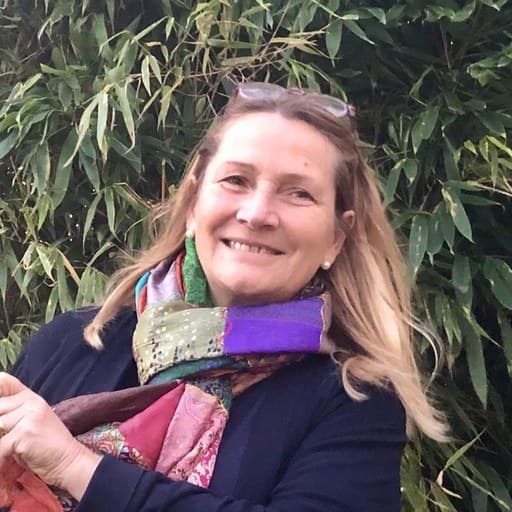
About the author
Valérie Fabre · Founder & Director, Harmonika Institute
Valérie Fabre founded Harmonika Institute in 2025, after a decade seeing clients in private kinesiology practice and, before that, thirteen years in international trade. A French-born polyglot who now splits her time between Dallas and Miami, she sets the school's curriculum and editorial standards and champions ethical, in-person training.
Read more about Valérie Fabre →