Journal · Reflexology · What it is
Hand Reflexology Chart: Zones, Sequence, and When Hands Beat Feet
Hand reflexology chart in table form (palm and back of the hand), a 20-minute two-hand sequence, and the 4 situations where hands replace feet.
Valérie Fabre, Founder & Director, Harmonika Institute · September 13, 2026 · 10 min read
Key takeaways
- The hand chart mirrors the foot chart. The same 10 longitudinal zones run from thumb to little finger. Fingers carry the head, the pads below them the chest, the centre of the palm the abdomen, the heel of the hand the pelvis. The thumb edge is the spine.
- Hands are worked when feet cannot be. Open wounds, fungal infection, a recent fracture or surgery, fragile skin from diabetes, or a client who cannot take shoes off at a desk. Our curriculum teaches hand protocols “for clients with foot contraindications”.
- A hand session is short. 20 to 30 minutes for both hands, against 45 to 60 for feet. The zones are smaller and the tissue thicker, so the pressure is more precise.
- The evidence is the same as for feet. Relaxation and short-term comfort are supported in small trials; organ-specific effects are not.
- Self-application suits hands better than feet. You can reach both hands, seated, in 5 minutes, which is why the hand chart is the one practitioners teach clients to take home.
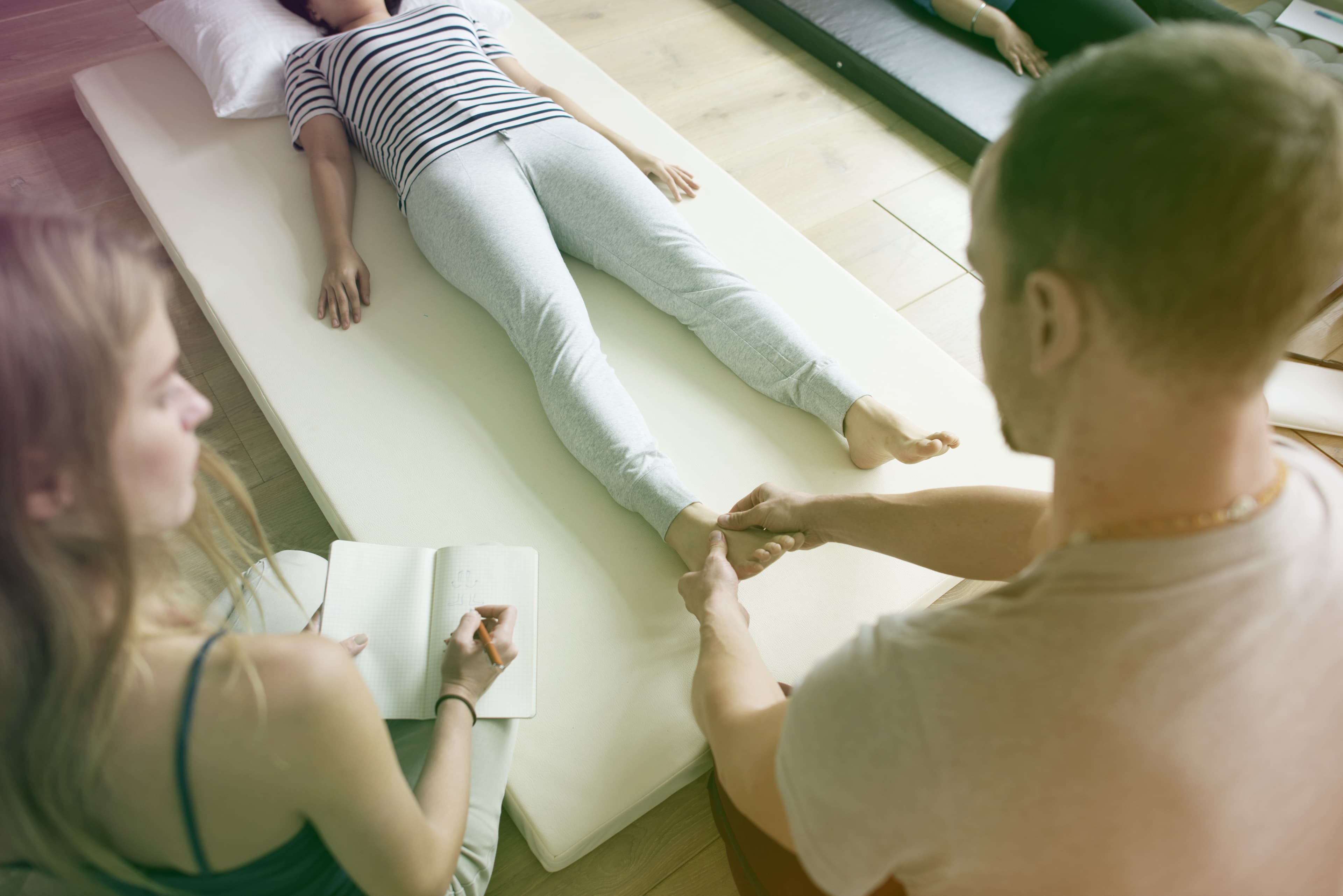
A client arrives with a walking boot on her left foot, six weeks after a fractured metatarsal. She booked a reflexology session because the last three helped her sleep. A practitioner trained only on feet has to send her home. A practitioner trained on the hand chart moves the session to a chair, works both hands for 25 minutes, and she leaves with what she came for. That switch is the whole point of hand reflexology, and it is why our reflexology curriculum gives hands and ears a module of their own.
This article gives you the hand chart in table form, the sequence of a two-hand session, and the situations where a practitioner picks hands over feet. If you have not read the foot version, start with our reflexology foot chart and its limits: the logic is identical and we do not repeat it here.
How is the hand reflexology chart laid out?
The hand chart uses the same ten longitudinal zones as the foot chart, running from the thumb (zone 1, the body's midline) to the little finger (zone 5, the body's edge). Turn a foot chart into a hand chart and almost every label survives the move: the fingers take the toes' job and carry the head and neck, the fleshy pads under the fingers become the chest, the soft centre of the palm becomes the abdomen, and the firm heel of the hand becomes the pelvis. The spine runs down the outer edge of the thumb and along the thumb side of the wrist, mirroring the inner arch of the foot.
Left and right follow the body, as on the feet. Our manual's anatomy vocabulary defines the term students use for this: homolateral, “on the same side of the body, for example the right foot and the right hand”. So the heart and spleen are charted on the left palm, the liver and gallbladder on the right, and paired organs on both.
| Region of the hand | Surface | Tradition assigns | Evidence for a specific link |
|---|---|---|---|
| Fingertips and finger pads | Palm side | Head, brain, sinuses, eyes, ears | None |
| Thumb, outer edge from tip to wrist | Both | Cervical to lumbar spine | None |
| Base of the thumb pad | Palm side | Neck, thyroid, throat | None |
| Pads below the four fingers | Palm side | Lungs, chest, shoulders | None |
| Centre of the palm, below the pads | Palm side | Diaphragm line and solar plexus | None |
| Soft centre of the palm, right hand | Palm side | Liver, gallbladder | None |
| Soft centre of the palm, left hand | Palm side | Stomach, spleen, pancreas | None |
| Heel of the hand, above the wrist | Palm side | Intestines, bladder, pelvis | None |
| Web between thumb and index finger | Both | Head and neck relaxation point | None |
| Between the metacarpal bones | Back of hand | Ribs, chest, lymphatic drainage | None |
| Wrist crease, both sides | Both | Hip, pelvic floor, reproductive organs | None |
| Whole hand, any zone | Both | Relaxation response from sustained touch | Consistent |
Palm or back of the hand: which map is which?
The palm corresponds to the sole of the foot and carries the organs. The back of the hand corresponds to the top of the foot and carries the surface structures: ribs, the spaces between them, the lymphatic points, and the breast area on the pads below the knuckles. A practitioner works both surfaces, exactly as the foot protocols in our manual work “the top and the underside of the foot” for the intercostal muscles and the trachea. The web between thumb and index finger appears on every chart and is the point clients ask about most; it is also a well-known acupressure point, which is a different tradition with its own rules and, in some states, its own licensing. We teach it as a reflexology relaxation point, with fingers only.
When do practitioners choose hands over feet?
In four situations, and the first is the one our curriculum names: when the feet carry a contraindication. Our program sheet lists “hand and ear protocols for clients with foot contraindications” among the things students learn, and Module 3 is built around them.
- The foot cannot be touched. An open wound, a fungal infection, a plantar wart, a recent fracture, surgery or sprain, heavy swelling, or a suspected clot in the calf (that last one is a referral, not a session). The hand chart lets the session go ahead on a different surface.
- The skin or sensation is fragile. Clients with long-standing diabetes may have reduced sensation and thin skin on the feet, which makes pressure hard to calibrate. Our manual's rule that pressure is “adjusted to the sensitivity and the available energy of the person” is easier to honour on a hand the client can see and feel.
- The setting is a chair, not a couch. A workplace wellness hour, a hospital bedside where the family has asked for comfort touch, a care home lounge, a client who cannot lift a leg onto a stool. Hands need no undressing and no table.
- The client wants to continue at home. Nobody can thumb-walk their own feet properly. Everyone can work their own hands at a red light.
Check your state
Hand reflexology is still touch for compensation. In states that fold reflexology into massage law, a hand session needs the same licence as a foot session; in states that carve reflexology out, the exemption usually covers hands and ears as well as feet, but read the wording. Working at a bedside or in a care setting adds the facility's own rules. Confirm with your state board before you advertise chair sessions.
What does a 20-minute hand session look like?
The same skeleton as a foot session, compressed. Our manual's protocols all open with relaxation moves, then the spine line, then the diaphragm line and solar plexus, before any system-specific work. On hands the whole arc fits in 20 to 30 minutes because each zone is a fraction of the size.
- 1
Intake and seating (3 minutes)
The client sits with forearms supported on a cushion or on the practitioner's lap. The manual's intake rule applies unchanged: record what the client reports, make no diagnosis, ask about wounds, jewellery, arthritis and any recent hand or wrist injury.
- 2
Relaxation moves (2 minutes per hand)
Slow stroking from wrist to fingertips, gentle rotation of the wrist, a light stretch of each finger. The practitioner settles their own posture first; the manual warns that tension in the practitioner's body “transmits to the client”.
- 3
Spine line (2 minutes per hand)
Thumb-walking along the outer edge of the client's thumb from the wrist (sacrum) to the tip (cervical). The manual calls the movement la chenille, the caterpillar: regular, rhythmic, from the torso rather than the finger joints.
- 4
Diaphragm line and solar plexus (1 minute per hand)
A horizontal thumb-walk across the palm below the finger pads in both directions, then a held pressure on the centre point. Clients often exhale visibly here.
- 5
Systems sweep (4 minutes per hand)
Finger pads for the chest, the soft palm for the abdomen, the heel of the hand for the pelvis, the back of the hand between the metacarpals for the ribs and lymphatics. The manual's ordering rule holds: “from the centre to the periphery”.
- 6
Close (2 minutes)
Both hands held at once, a slow stroke from wrist to fingertips, a glass of water offered. Both hands, always: the manual's instruction to “always work both feet” carries over.
How does hand technique differ from foot technique?
Smaller targets, thicker tissue, and a client who is watching. The zones on a palm are a third the size of their foot equivalents, so a thumb that walks in 5-millimetre steps on a foot walks in 2 or 3 on a hand. The palm's tissue is dense and the bones are close to the surface, so pressure is precise rather than heavy. The manual's principle for feet holds even more on hands: the pressure “must come mainly from the movement of the torso and the arm, and not only from the strength of the fingers”, because a practitioner who works from the thumb joint alone is sore by the third client.
The four hand techniques carry over. Thumb-walking for long zones; sustained point pressure with the thumb, index or a bent knuckle; a deep repeated glide along the thumb edge; and the pinch, taking a point between thumb and index finger across the back and palm at once. The pinch matters more on hands than feet, because the back of the hand is thin and cannot take direct thumb pressure comfortably.
What the evidence shows
Hand reflexology has been tested in a handful of small trials, mostly in hospital settings, on anxiety before procedures and on comfort during long hospital procedures such as dialysis. They report short-term reductions in self-rated anxiety, with no blinding and no control for simple hand-holding. The National Center for Complementary and Integrative Health (nccih.nih.gov) does not list any condition for which reflexology, foot or hand, has strong evidence. Say relaxation. Say nothing about organs.
What can a practitioner honestly say about hand reflexology?
That it is a relaxing, structured touch session that can be given almost anywhere, and that it accompanies medical care without replacing it. In our cohorts we rehearse the exact sentence, because the hand chart invites the same overreach as the foot chart: a client with a sore liver zone and a known liver history will connect the dots, and a practitioner who agrees has made a medical claim. The neutral answer is “that area is sensitive today; if it worries you, ask your medical provider”. We cover the marketing version of the same discipline in our review of what reflexology's evidence supports.
Can you do hand reflexology on yourself?
Yes, and it is the one part of reflexology that works well as homework. Five minutes, seated, no equipment. Use the thumb of one hand to walk slowly along the outer edge of the other thumb from wrist to tip, then across the palm below the fingers, then a held pressure in the centre of the palm for three slow breaths. Swap hands. Stop over any cut, swelling or acute pain. In our program, students learn the hand chart in Module 3 and practise it on each other with an instructor correcting their grip: our in-person reflexology program runs 9 classroom days (63 teaching hours), for $3,500.
From the training floor
Students who have already learned feet tend to press too hard on hands in their first week of Module 3, because the foot has taught their thumb a pressure the palm does not need. The correction is visible: the client's shoulders rise. We ask students to watch the shoulders, not their own thumb, for the first ten hand sessions.
Hands are the second map. The third, and the one with the most confusion around it, is the ear, which we cover in ear reflexology and the auricular map, including where touch stops and needle-based auriculotherapy begins.
Questions on this topic.
Is hand reflexology as effective as foot reflexology?+
For relaxation, the small trials that exist show similar short-term effects, and neither surface has evidence for organ-specific results. Practitioners generally prefer feet when both are available, because the zones are larger and easier to work with precision and the client is lying down. Hands win when the feet cannot be touched, when the setting is a chair, or when the client wants a routine to continue at home.
Which hand do you use for reflexology?+
Both, always. The left hand represents the left side of the body and the right hand the right side, so paired organs appear on both palms while the heart and spleen are charted on the left and the liver and gallbladder on the right. A session works one hand fully, then the other, and closes with both held together. Working a single hand leaves the map half covered.
Where is the pressure point for stress in the hand?+
Most hand charts name two: the centre of the palm, which reflexology labels the solar plexus point, and the web between thumb and index finger. Practitioners hold either with steady thumb pressure for three to five slow breaths. Neither point has evidence beyond the relaxation that comes from sustained, attentive touch, and neither should be used as a substitute for care if stress is affecting your health.
Can hand reflexology be done through clothing or with lotion?+
Hands are worked bare, and usually dry. A light cream can help with very dry skin but makes thumb-walking slide, so most practitioners use little or none. Rings and watches come off before the session. Because no undressing is needed, hand sessions are the format practitioners use in workplaces, waiting areas and care settings where a full foot session would be impractical.
How often should you do hand reflexology?+
For self-application, a five-minute routine once or twice a day is comfortable for most people, with no evidence that more is better. For professional sessions, weekly or fortnightly is the common rhythm during a period when someone wants support with sleep or stress, then monthly. Stop or shorten sessions if the hands become sore, and skip any area with a cut, swelling, inflammation or a recent injury.
Is hand reflexology safe for people with arthritis?+
Often, with adjustments. Gentle stroking and light thumb-walking on hands with mild arthritis is usually well tolerated and many clients find it soothing. Swollen, hot or acutely painful joints are avoided entirely, and the practitioner works around them with lighter pressure elsewhere. A client with an inflammatory condition should mention the session to their medical provider. Reflexology accompanies that care; it does not treat the condition.
Does a reflexology certification cover hands and ears?+
Not always, so ask before you enrol. Many short courses teach feet only. The American Reflexology Certification Board's national exam includes hands and feet, and serious programs teach the ear map as well. Our own curriculum devotes Module 3 to hand and ear maps and full session protocols, precisely so that a graduate can work with a client whose feet carry a contraindication.
What is the difference between hand reflexology and acupressure?+
The map and the tradition. Hand reflexology uses the zone chart, a Western system from the early 1900s that lays the body over the hand. Acupressure uses points on the meridians of Chinese medicine, a different map with its own theory. Some points overlap physically, such as the web of the thumb. Both are done with fingers only; anything with needles is acupuncture and requires a state licence.
Tags:
ReflexologyWhat it is
About the author
Valérie Fabre · Founder & Director, Harmonika Institute
Valérie Fabre founded Harmonika Institute in 2025, after a decade seeing clients in private kinesiology practice and, before that, thirteen years in international trade. A French-born polyglot who now splits her time between Dallas and Miami, she sets the school's curriculum and editorial standards and champions ethical, in-person training.
Read more about Valérie Fabre →