Journal · Reflexology · What it is
What Is Reflexology and How Do the Foot Maps Work
What the reflexology foot map actually claims, why anatomy does not back it up, and what genuinely happens during an hour on the table with your shoes off.
Valérie Fabre, Founder & Director, Harmonika Institute · May 7, 2026 · 10 min read
Key takeaways
- The map is a tradition, not an anatomical finding. No nerve pathway connects the ball of your left foot to your heart. The chart is a teaching convention roughly a century old.
- The session itself is real and specific. Forty-five to sixty minutes, shoes and socks off, everything else on, firm thumb pressure worked systematically across both feet. About one in four people fall asleep.
- Evidence supports comfort, not cure. Reviews find modest short-term effects on self-reported anxiety, pain perception and sleep quality, with weak study designs throughout.
- Expect $60 to $130 an hour in most U.S. markets, higher in New York, Boston and Los Angeles.
- Tender spots do not diagnose anything. If a practitioner presses your arch and announces that your liver is congested, leave. That claim is outside anyone's scope and, in several states, outside the law.
You take off your shoes and socks, lie down fully clothed, and someone spends the better part of an hour working their thumb across the sole of your foot in slow, deliberate lines. At some point they press a spot near the base of your big toe and you flinch, and they say something about the neck. That moment is where most people either become curious about reflexology or decide it's nonsense. Both reactions are reasonable, and neither is quite right.
Where the foot maps came from
Pressure work on the feet shows up in a lot of places historically. There's a well-known relief in the tomb of Ankhmahor at Saqqara, dated around 2330 BCE, showing hands working on feet. Chinese traditions of foot pressure run back centuries. None of these produced the chart you'll see on the wall of a reflexology room.
That chart is much newer, and American. William Fitzgerald, an ear, nose and throat physician in Connecticut in the 1910s, proposed what he called zone therapy: the body divided into ten vertical zones, five per side, running from the toes to the top of the head. Press somewhere in a zone, he argued, and you affect the whole zone.
Eunice Ingham, a physiotherapist, took those zones in the 1930s and did the thing that made reflexology what it is now. She mapped specific organs onto specific locations on the sole, drew it, and taught it to non-medical practitioners across the country. Practically every foot chart in circulation traces back to her drawings.
That history tells you what kind of object the map is. Not the product of dissection or imaging. A system one person designed, refined by feel, and passed on because it worked well enough as a way of organising a session.
| Area of the foot | Traditionally linked to | What is physically there | How it usually feels |
|---|---|---|---|
| Toe pads and tips | Head, sinuses, brain | Dense nerve endings, thin tissue over bone | Sharp, quick, often surprisingly sensitive |
| Base of the big toe | Neck and cervical spine | First metatarsophalangeal joint | Tender in most people who sit at a desk |
| Ball of the foot | Chest, lungs, heart on the left | Metatarsal heads and the plantar fascia's forward attachment | Broad, dull, easy to take |
| Arch, upper half | Stomach, liver, gallbladder, spleen | Mid plantar fascia, flexor tendons | The most commonly tender region overall |
| Arch, lower half | Intestines, lower abdomen | Soft tissue, less fascial tension | Usually comfortable, sometimes ticklish |
| Heel | Pelvis, sciatic region, lower back | Thick fat pad, calcaneus, fascia insertion | Needs real pressure to register at all |
| Inner edge, toe to heel | The whole spine | Medial arch, tibialis posterior insertion | Firm, rarely painful |
Does the map correspond to anything in the body?
Not in the way the chart implies. This needs stating clearly rather than hedged into vagueness.
There is no anatomical structure connecting a discrete patch of the sole to a specific internal organ. Nerves from the foot run to the spinal cord and up; they do not branch off to the pancreas. Circulatory and lymphatic routes don't work that way either. When studies have tested whether practitioners can identify a known medical condition from the feet alone, they have generally failed to do better than chance.
Where the evidence sits
Systematic reviews reach a two-part conclusion. First, trials repeatedly report short-term improvements in self-reported anxiety, perceived pain and sleep quality, often in hospital and cancer-care settings where the work is offered as comfort care alongside standard treatment. Second, those trials are small, rarely blinded, and almost never compare reflexology against an equally attentive session of plain foot massage. That last omission matters, because it's the comparison that would tell you whether the map does anything.
The reasonable summary: people feel better afterwards, fairly reliably. That the map is doing the work is unsupported. No credible evidence exists for treating any disease.
So why does the map survive? Two honest reasons.
It's an excellent protocol. A practitioner following a foot chart covers every square centimetre of both feet in a consistent order, at consistent depth, without skipping. Compare that with an unstructured foot rub, which drifts to whatever feels nice and misses half the surface. The map is a checklist wearing a metaphysical costume, and checklists work.
It also gives the client a frame. Being told the tender spot under your arch relates to how you've been eating gives you something to think about, and that conversation is often the most useful part of the appointment. Not nothing. Just not physiology.
What actually happens in a session
Here's the part that gets buried under the theory. The experience itself is pleasant and quite unlike a massage.
Before you lie down
A first appointment opens with ten minutes of questions. Foot problems, recent injuries, diabetes, circulation issues, pregnancy, medications. A competent practitioner is asking to know what to avoid, not to diagnose you. They should also tell you, unprompted, that this doesn't replace medical care.
The setup
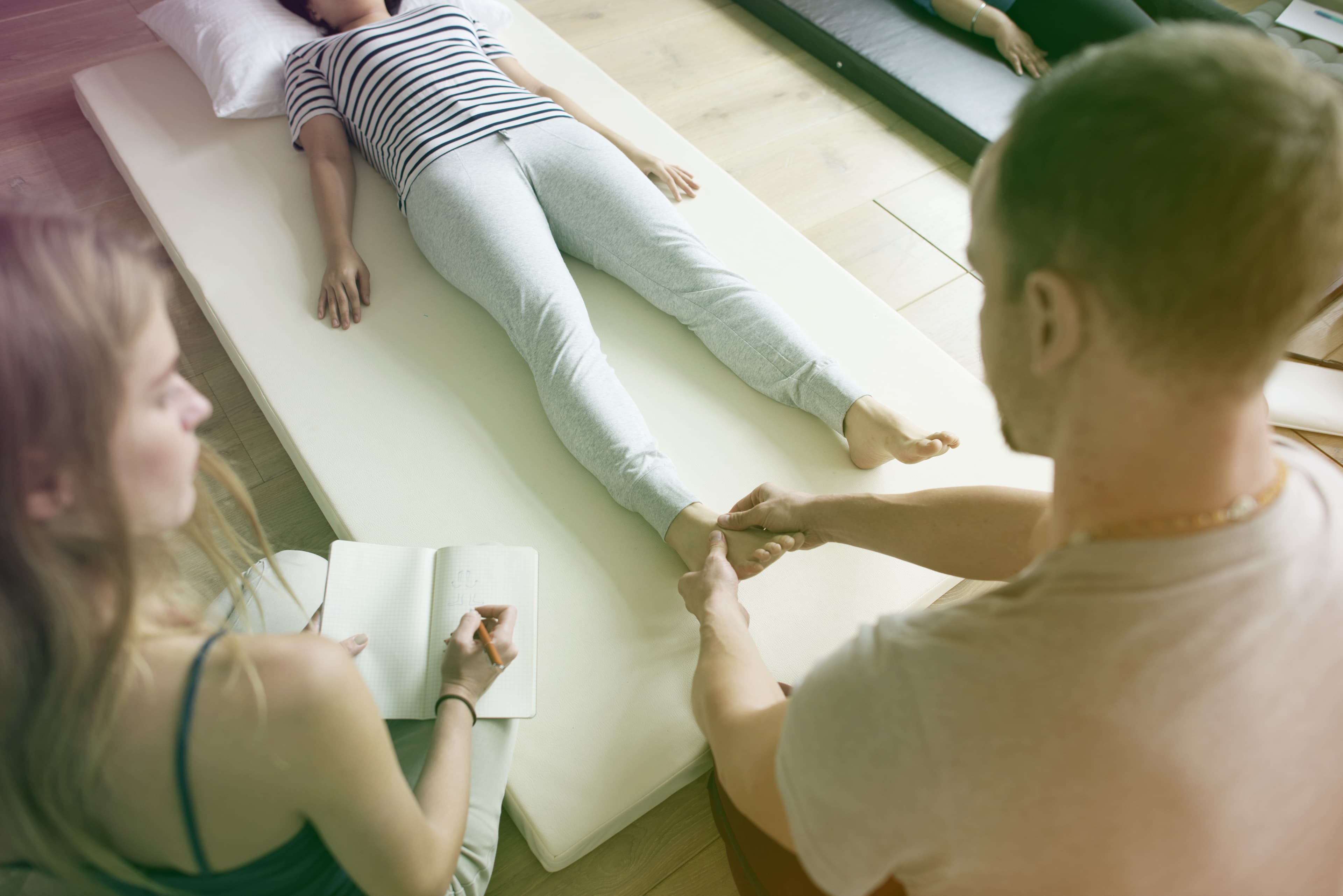
You keep your clothes on. Shoes and socks come off, trousers roll up to mid-calf. You lie on a padded table or sit in a heavily reclined chair, usually with a bolster under your knees and a blanket available. The practitioner sits at the end facing your soles and cleans your feet with a warm cloth.
The hour itself
They start with a few minutes of holding and warming, then move into the work proper. The signature technique is thumb walking: the thumb bent at the first joint, inching forward in small caterpillar-like steps under steady pressure. Fingers do the same on top of the foot. Nothing glides, which is why traditional reflexology uses no oil, though many practitioners use a little balm at the end.
They'll work one foot fully, then the other, following the same route each time, typically toes first and heel last. Expect roughly twenty-five minutes per foot in a sixty-minute appointment.
Pressure is firm. Considerably firmer than most people expect, particularly on the heel. It should register as strong but not as pain, and any decent practitioner will ask you to rate it and adjust. Some spots will be tender, which is normal and doesn't mean something is wrong with the corresponding organ.
Conversation varies. Some practitioners talk throughout, some barely at all. Say which you prefer. You're allowed to.
The ticklish question
Nearly everyone worries about this and almost nobody needs to. Ticklishness is a response to light, unpredictable touch. Reflexology pressure is deep and steady, which switches the response off within about a minute. If you're anxious about it, ask them to open with firm holding pressure on the whole foot rather than detail work on the toes. It resolves.
Afterwards
Most people feel heavy, warm and slightly spaced out for fifteen minutes or so. Around a quarter fall asleep during the session. Practitioners will tell you to drink water, and while the usual explanation about flushing toxins doesn't hold up, sitting quietly with a glass of water before you drive is good advice after any hour of deep relaxation.
A minority feel mildly off for a day: tired, a bit emotional, occasionally a headache. Common enough that practitioners have a name for it, harmless enough that it doesn't warrant one.
Who should skip it, and who should ask first
Reflexology is low-risk, which is not the same as no-risk.
Don't book a session if you have an open wound, an active infection, athlete's foot in a shareable state, a recent fracture, or a suspected deep vein thrombosis. That last one matters: pressure on a leg or foot with a clot is dangerous, and if you have unexplained swelling, warmth and pain in one calf, you need a physician, not a table.
Ask your own physician first if you have diabetes with any neuropathy, since you may not feel pressure accurately and skin heals slowly. Same for peripheral arterial disease, an active gout flare, or anticoagulants. In pregnancy, many practitioners work with pregnant clients happily and some decline the first trimester as policy; that caution is about liability as much as physiology.
What a session may not be
Reflexology is not a diagnostic method and no practitioner may present it as one. Nobody working on your feet can tell you the state of an organ, identify a condition, or advise you to stop or change a prescribed medication. A tender point means tender tissue. That's the whole claim.
Regulation varies by state. Some treat reflexology as part of massage practice and require a massage licence to work for compensation; some have separate registration or a written exemption for foot-only work; some don't address it at all. This changes, and city rules add another layer. If you're considering practising rather than receiving, confirm your position with your own state board. We map the categories in our state credentialing guide.
Reflexology, foot massage, and the spa in between
People use the words interchangeably and shouldn't. The differences affect what you're paying for.
| Reflexology | Foot massage | Spa or salon foot treatment | |
|---|---|---|---|
| Goal | Systematic pressure across a mapped sequence | Release tension in foot muscles and fascia | Comfort and grooming |
| Technique | Thumb walking, static pressure, no glide | Effleurage, kneading, stretching, usually with oil | Soak, scrub, light rub, polish |
| Length | 45-60 minutes | 20-30 minutes, often part of a longer session | 10-15 minutes inside a pedicure |
| Clothing | Fully clothed, calves exposed | Fully clothed or draped | Fully clothed |
| Training behind it | 200-500 hours in a dedicated program | Part of 500-1,000 hour massage licensure | Cosmetology or nail technician licence |
| Licence usually required | Depends on state | Yes, in most states | Yes, cosmetology |
None is better than the others. They're different purchases. Want your feet to feel good for an afternoon? The salon is cheaper. Have plantar fasciitis? You want a licensed massage practitioner or a physical therapist. Want an hour of unhurried attention that drops your nervous system a gear? Reflexology does that well.
How to find someone competent
Ask three questions before booking.
- 1
Where did you train, and for how many hours?
A serious answer is a named school and a number in the low hundreds of hours with supervised practice included. A weekend online course is a different animal. If they hold national board certification, they'll mention it unprompted.
- 2
What do you tell clients reflexology does?
You want to hear about relaxation, comfort and stress. If the answer includes detoxifying, rebalancing organs, or treating a named condition, you've learned what you needed to learn.
- 3
What would make you refer me elsewhere?
A good practitioner answers immediately: foot pain that isn't resolving, anything vascular, anything they can't explain. Someone who says they can help with everything cannot help you with much.
Price tracks market rather than quality. Expect $90 to $130 in New York, Boston, Los Angeles and Seattle, $60 to $90 across much of the Midwest and South. Most practitioners suggest weekly for a month before spacing out, which is a reasonable structure and also, be aware, a sales structure.
If you're wondering about training rather than booking
Some people read a page like this and find the question has flipped: not what happens in a session, but whether they could run one.
Reflexology attracts people who want structured hands-on work without the scope of full-body massage. Training is shorter than massage licensure, the equipment is a chair and a stool, and it asks less of your own body than deep tissue work. That last point is why a meaningful number of practitioners come to it in their forties and fifties.
The honest caution: the same map you've just read a sceptical account of is what you'll be taught. Good training teaches it as a system for organising your hands and is straightforward about the rest. Poor training teaches it as anatomy. Ask which you're getting, in those words, before you pay.
Questions on this topic.
Does reflexology hurt?+
It shouldn't, though certain points will be tender. The pressure is firm and steady, most noticeably on the heel and along the inner arch, and people expecting a gentle foot rub are often surprised by how strong it is. Tenderness in a spot usually means the tissue there is tight or the bone is close to the surface, not that something is wrong internally. Say something the moment it crosses from strong into painful. A practitioner who doesn't adjust when asked is one you don't go back to.
How many sessions do I need?+
For general stress and sleep, most people know whether it suits them within one or two sessions. If it does, monthly maintenance is the common pattern. Be sceptical of anyone selling a twelve-session package upfront to a first-time client. There's no evidence base establishing a required course of treatment, because there's no treatment being established.
Can reflexology be done on hands and ears instead of feet?+
Yes. Hand and ear maps exist alongside the foot map and follow the same logic. Hand reflexology is useful when feet are unavailable, whether from injury, infection, or plain discomfort with having feet touched, and it's the version most practitioners teach for self-use at home. Ear work overlaps with auriculotherapy, a separate tradition. The foot map remains the standard because feet have more surface area and people find the sessions more relaxing.
Why do I feel tired or emotional the next day?+
It's a common report and it isn't toxins leaving your body. The likelier explanation is unremarkable: an hour of deep relaxation shifts you out of a sustained stress state, and coming out of that often surfaces tiredness that was already there. Some people also process emotionally during any prolonged quiet contact. Treat it the way you'd treat a heavy nap. If it lasts more than a day or two, mention it to your physician rather than your practitioner.
Is reflexology covered by health insurance?+
Almost never as a standalone service in the United States. Exceptions exist inside hospital comfort-care or oncology support programs, or where a flexible spending account allows it with documentation. Some plans with complementary care riders cover it if the provider also holds a massage licence. Assume you're paying out of pocket and check with your plan first.
Tags:
ReflexologyWhat it is
About the author
Valérie Fabre · Founder & Director, Harmonika Institute
Valérie Fabre founded Harmonika Institute in 2025, after a decade seeing clients in private kinesiology practice and, before that, thirteen years in international trade. A French-born polyglot who now splits her time between Dallas and Miami, she sets the school's curriculum and editorial standards and champions ethical, in-person training.
Read more about Valérie Fabre →