Journal · Reiki · What it is
Reiki Symbols: What the Three Level 2 Symbols Are For
The 3 Reiki symbols of Level 2 and the master symbol: name, function, where each is used in a session, why they are public, and why a drawing does nothing.
Valérie Fabre, Founder & Director, Harmonika Institute · September 13, 2026 · 9 min read

Key takeaways
- There are three symbols at Level 2 and one at Master level. Cho Ku Rei (power), Sei He Ki (mental and emotional), Hon Sha Ze Sho Nen (distance), and Dai Ko Myo, given at Shinpiden.
- Each symbol comes with a spoken phrase. Our Reiki manual pairs a mantra with each: power “increases the available energy and brings protection”, harmony “links the unconscious, the conscious and the superconscious”, distance is “invoked during distance sessions”.
- They stopped being secret around 1995. Takata's students were taught them orally and told to destroy their drawings; since the mid-1990s they have been printed in books and are one search away.
- A symbol without an attunement and practice is a drawing. In the lineage the symbol is a cue that a trained practitioner attaches to a state; nothing in a trial suggests the ink itself does anything.
- They are used at 4 points in a session. In the opening intention, over the hands, over a specific position, and at the close; we teach all four in person in Module 3, on a 5-day program (35 teaching hours).
Around 5,400 people a month search “reiki symbols”, and most of the pages they land on either sell the symbols as secret keys or mock them as doodles. Both miss what a symbol is in a Reiki lineage: a shape and a phrase that a practitioner has been taught to associate, through an attunement and weeks of repetition, with a particular way of working. Our Reiki manual treats them as “mantras associated with the Reiki symbols” and gives a phrase for each. This article gives you the names, the functions, the phrases in English, and the honest limits.
If you are still working out what the levels are, start with what each Reiki level actually lets you do; the symbols arrive at Level 2 and this article assumes you know why. For what happens in a session from the client's side, see what Reiki is and what actually happens in a session.
What are the Reiki symbols, and how many are there?
Four, in the Usui lineage as it reached the West: three taught at the second level, Okuden, and one at the master level, Shinpiden. Each has a Japanese name, a shape drawn in the air or traced on the palm, and a function. Our curriculum lists them in Module 3, “Okuden (Reiki II): second attunement, the three sacred symbols, mental/emotional and distance practice”, and the master symbol in Module 5. Different lineages draw them slightly differently and some add symbols of their own; the four below are the ones every Usui-descended line recognises.
| Symbol | Level | Common gloss | Function | Our manual's phrase |
|---|---|---|---|---|
| Cho Ku Rei | Level 2 (Okuden) | “Place the power here” | Focus and amplify; open and close a session; protection | “All the energy of the Universe: be present.” |
| Sei He Ki | Level 2 (Okuden) | “Harmony”, “as it should be” | Mental and emotional work; habits, anxiety, old patterns | “Man and God are one.” |
| Hon Sha Ze Sho Nen | Level 2 (Okuden) | “No past, no present, no future” | Distance sessions; working across time and space in the tradition's terms | “The God in me reaches out to the God in you, and we become one.” |
| Dai Ko Myo | Master (Shinpiden) | “Great bright light” | Attunements; transmitting the practice to students | Not paired with a phrase; a fourth mantra, guidance, is used instead: “Reiki, guide my hands where they are needed.” |
One honest note on the table. The Japanese glosses are the ones commonly given in Western Reiki books and are approximate; the symbols were transmitted as drawings and sounds, not as dictionary entries. We teach the glosses as memory aids, not as translations.
What is each symbol actually for?
The power symbol
Focus. Cho Ku Rei is the one practitioners use most, and the one beginners overuse. Our manual describes its mantra as one that “increases the available energy, brings protection and transforms the energies in us and around us”. In practice it marks a beginning and an end: drawn over the palms before the first hand position, drawn over the client's body at the close. Think of it as the practitioner's way of saying “now” to themselves.
The mental and emotional symbol
Sei He Ki is the symbol for work on states of mind, and the manual's description is the most psychological of the four. Its mantra, the manual says, “links the three parts of the human being: the unconscious (repressed suffering), the conscious (the ego, what we identify with every day) and the superconscious, that is the higher consciousness (intuition, the Soul, the Spirit), for the balance of the psyche, the emotions and the body”. Practitioners draw it over the head positions in the manual's psycho-emotional protocol. It is not a technique for treating anxiety or depression; those belong to licensed care. It is a cue the practitioner uses to hold a particular intention while their hands are on the client's temples.
The distance symbol
Hon Sha Ze Sho Nen is used when the client is not in the room. The manual says the mantra “is invoked during distance sessions and connects us to the sixth chakra, to strengthen the vision of the third eye”. Whatever you make of that claim, the practical use is consistent across lineages: it is drawn at the start of a distance session to mark the connection and, as the manual insists, the link is “released at the end”. The manual devotes a chapter to distance work and is candid that it relies on “thought, and more precisely telepathy or visualisation”. We teach it as the tradition teaches it, and we say in the same breath that no trial supports an effect at a distance.
The master symbol
Dai Ko Myo is given at Shinpiden and used in attunements, the ritual by which a teacher passes the practice to a student. It is the only symbol whose use is reserved: a Level 2 practitioner has no occasion for it. What an attunement is, and why we only do them in the room, is its own subject, covered in what a Reiki attunement is.
Are the Reiki symbols secret?
They were, and they are not. Hawayo Takata, who brought Reiki from Hawaii to the mainland United States, taught the symbols orally and required students to memorise and destroy their drawings; for decades the symbols circulated only inside the teacher-student relationship. That ended in the mid-1990s when they were printed in widely sold books, and today they are on the first page of any image search. Some lineages still ask students to keep them private as a matter of respect. We keep that convention in our public writing, which is why this article describes the symbols and does not draw them. The reason is courtesy, not a belief that seeing a shape harms anyone.
From the training floor
Every Level 2 cohort has one student who arrives having already downloaded the symbols, and one who is disappointed that they are not more elaborate. Both discover the same thing in week two: they can draw the shape perfectly and it changes nothing until they have practised the sequence that goes with it enough times for the shape to call up the state on its own. The symbol is the label on the drawer, not the contents.
Why is a symbol without an attunement just a drawing?
Because in the lineage the symbol has no independent power; it is attached to something. At Okuden the student receives a second attunement, is shown the three symbols, and then practises drawing them and speaking the phrases at set points in the session, on themselves and on classmates, until the gesture is automatic. Our manual's instruction is that the mantras are “to be invoked before every self-session, before every consultation, or during a block or difficulty”. After enough repetitions, drawing the symbol reliably brings the practitioner into the focused, quiet state the session needs. That is a real effect, and it is the practitioner's, not the ink's. Someone who copies the shape from a website has the label and none of the training the label points to.
What the evidence shows
Controlled trials of Reiki, summarised by the National Center for Complementary and Integrative Health (nccih.nih.gov), show relaxation and reduced self-rated anxiety that sham Reiki, delivered by untrained actors, generally matches. No trial has isolated the symbols or tested a Level 2 practitioner against a Level 1 practitioner. The honest reading is that the symbols shape the practitioner's attention and ritual, which clients feel as calm and care, and nothing measurable beyond that.
How are the symbols used inside a session?
At four points, and the manual's session structure fixes where. Each is a few seconds; a client would not notice unless told.
- 1
In the opening intention
The manual's opening phrase asks “the universal life energy, called Reiki, invested with these active symbols” to be present for the client's highest good. The power symbol is drawn over the palms as the phrase is spoken.
- 2
Over the hands, before contact
The manual has the practitioner make first contact at the shoulders, hands or feet and, if needed, “rub the hands together”. Level 2 practitioners trace the power symbol on each palm first.
- 3
Over a position, for a specific intention
The mental and emotional symbol over the head positions in the psycho-emotional protocol; the distance symbol at the start of a distance session. The manual's 18-position general protocol needs neither; symbols are added, not required.
- 4
At the close
The power symbol over the body from head to feet during the closing sweep the manual calls “harmonising the aura”, then the hands placed under the feet to ground the session. In distance work, the link is released with a spoken phrase.
Do you have to believe in the symbols for Reiki to work?
No, and neither does the client. The tradition frames the symbols in spiritual language, and our manual's mantras speak of God and the Universe; students from every background and none train with us and use the phrases as they choose, as the manual itself allows: “formulate the prayers according to your beliefs, the circumstances, or a simple intention”. Whether that makes Reiki a religion is a question we take seriously and answer in is Reiki a religion?. What matters for the symbols is narrower: they work as cues for the practitioner's attention, and attention does not require belief.
Scope of practice
A symbol is not a treatment and a Reiki practitioner does not treat. Our manual's ethics chapter is blunt: the practitioner “does not heal! He promises nothing.” He “accompanies”, refers clients to specialists, and “states that medical treatments are to be followed as their medical provider indicates”. The mental and emotional symbol in particular is never a substitute for licensed mental health care, and a practitioner who implies it is has stepped outside scope. Title and practice rules for Reiki vary by state; check yours.
Why do we teach the symbols in person?
Because the symbol is learned as a movement, corrected by a teacher, not as a picture. The stroke order, the size, the moment in the session, the phrase spoken with it, the hands that hold still afterwards: all of that is watched and adjusted in the room, and it is the part that turns a shape into a practice. In our in-person Reiki program the three Level 2 symbols are taught in Module 3 and the master symbol in Module 5, across 5 classroom days (35 teaching hours), for $1,500. I chose to keep the symbols and the attunements in the same room, because I have never seen a screen correct a stroke.
Questions on this topic.
What do the three Reiki symbols mean?+
Cho Ku Rei is the power symbol, used to focus and to open and close a session; its common gloss is “place the power here”. Sei He Ki is the mental and emotional symbol, used over the head positions for work on states of mind; its gloss is “harmony”. Hon Sha Ze Sho Nen is the distance symbol, used when the client is not present; its gloss is “no past, no present, no future”. The glosses are approximate memory aids, not translations.
Can I use Reiki symbols without being attuned?+
You can draw them; nothing stops you and nothing happens. In the lineage a symbol is a cue attached, through an attunement and repeated practice, to a way of working the practitioner has been trained in. Without that training the shape has nothing to point to. No trial shows the symbols have an effect of their own, so the honest answer is that drawing them untrained is harmless and pointless in equal measure.
Which Reiki symbol is the most powerful?+
The lineage does not rank them, and practitioners who do are usually selling something. The power symbol, Cho Ku Rei, is the most used because it opens and closes every session and can be added to any position. The master symbol, Dai Ko Myo, is the most restricted because only teachers use it, in attunements. Neither has been tested in a trial, and the word “powerful” describes the tradition's language, not a measured effect.
How do you draw the Reiki symbols?+
In the air with the flat hand or the fingers, or traced on the palm, following a fixed stroke order taught at Level 2, while speaking the associated phrase silently or aloud. The drawing takes two or three seconds. The stroke order, size and timing are corrected by a teacher in the room, which is why serious programs teach the symbols in person. Printed versions differ slightly between lineages; a student follows their own teacher's version.
Are there more than four Reiki symbols?+
In the Usui lineage as taught in the West, four: three at Level 2 and one at Master level. Some later branches such as Karuna Reiki or Seichim add symbols of their own, and some Japanese lineages teach kotodama, spoken sounds, alongside or instead of the drawings. A program that promises dozens of secret symbols is offering its own invention, which it may do, but it is not Usui Reiki and should not be priced as if it were.
Why are Reiki symbols kept secret?+
They were kept private for most of the twentieth century because Hawayo Takata taught them orally and had students destroy their drawings, treating them as part of the teacher-student bond. Since the mid-1990s they have been published in books and appear in any image search, so the secrecy is now a courtesy convention rather than a fact. Some lineages, including ours in public writing, keep the convention out of respect; none claims that seeing the shapes causes harm.
What is the master symbol in Reiki?+
Dai Ko Myo, commonly glossed as “great bright light”. It is given at the third level, Shinpiden, and its use is reserved for attunements, the ritual by which a teacher transmits the practice to a student. A Level 2 practitioner has no occasion to use it. Our own manual pairs its three Level 2 symbols with mantras and adds a fourth mantra, for guidance, used to prepare a session: “Reiki, guide my hands where they are needed.”
Do Reiki symbols have any scientific basis?+
No trial has isolated the symbols or compared Level 2 practitioners with Level 1 practitioners. Trials of Reiki as a whole show relaxation and lower self-rated anxiety that sham Reiki by untrained actors generally matches, which points to attentive touch and calm rather than to anything specific to the symbols. The reasonable view is that the symbols organise the practitioner's attention and ritual, which clients experience as care, and that nothing beyond that has been measured.
Tags:
ReikiWhat it is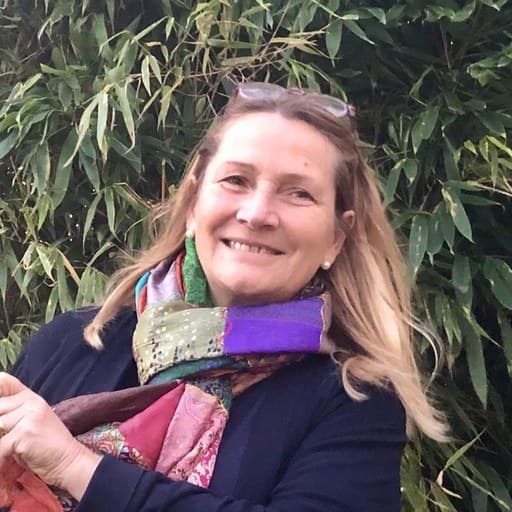
About the author
Valérie Fabre · Founder & Director, Harmonika Institute
Valérie Fabre founded Harmonika Institute in 2025, after a decade seeing clients in private kinesiology practice and, before that, thirteen years in international trade. A French-born polyglot who now splits her time between Dallas and Miami, she sets the school's curriculum and editorial standards and champions ethical, in-person training.
Read more about Valérie Fabre →